Foderdeg for Bees: The Recipe Is Not to Cook It
By Adam M Akkemik — beekeeper in Svinninge · Jordbruksverket registered · Biodlarna Stockholm member
Sugar paste is a commodity — buy it ready-made and knead the supplements in cold. Our own method and where it sits in the year: 13 litres of syrup in autumn, then tablets and 2 kg of fondant as a reserve placed ahead of time, then a pollen cake once it passes 13 degrees. Why no heat, why solid feed, and why foderdeg is not a pollen cake.
One thing first: you do not cook foderdeg for bees. You buy the paste ready-made and knead into it whatever you want it to carry. That is how we do it at Svinninge, and it is why this page is short.
How we do it — the method
1. Buy ready-made fondant. We use a third-party fondant. Sugar paste is a commodity and we do not manufacture it.
2. Keep it cold, or barely lukewarm. Lukewarm paste kneads more easily. It should not be warm — the reasons are below.
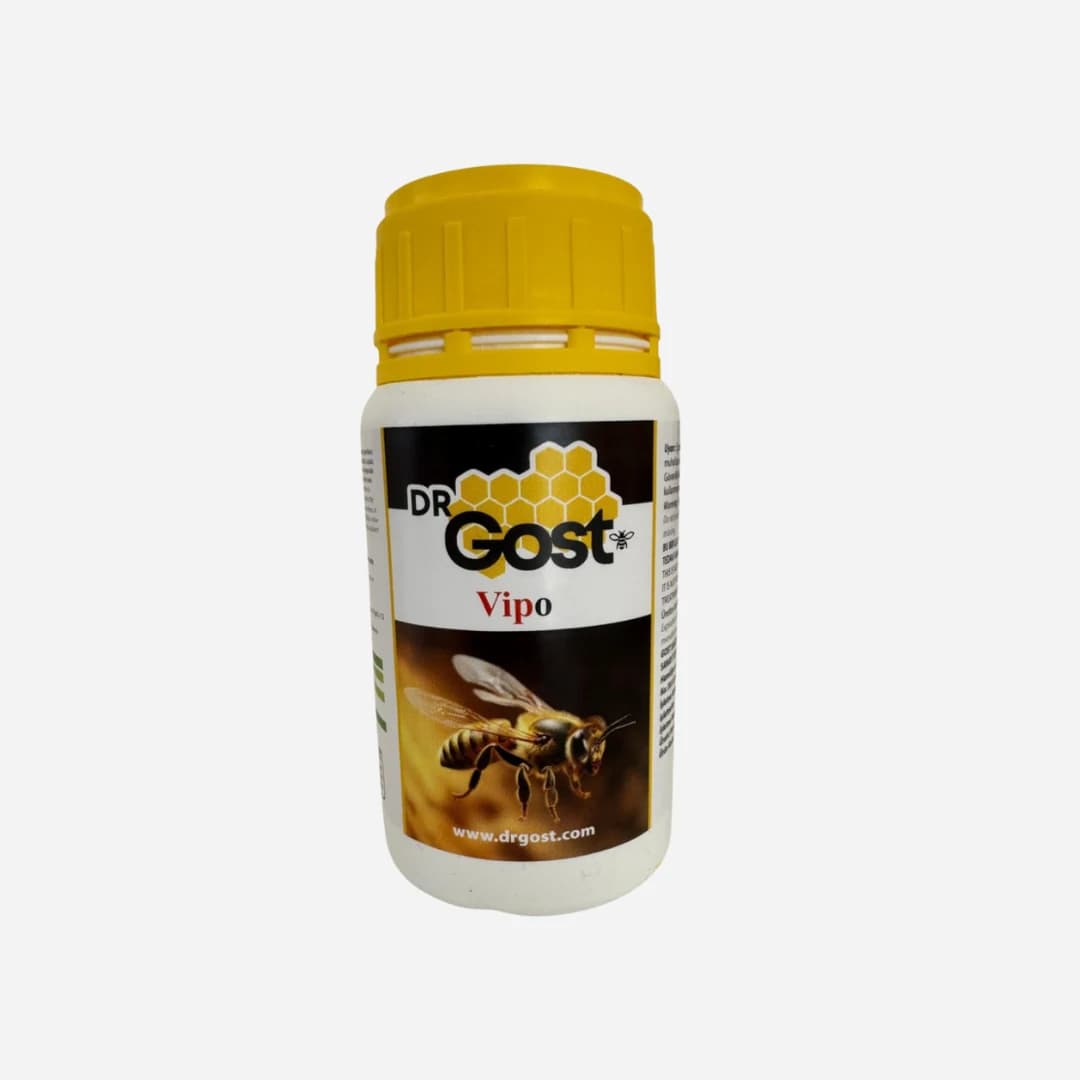
3. Sprinkle in Vipo — probiotics, prebiotics, vitamins, vegetable protein and amino acids in powder form. The label gives 2 g, about a teaspoon, per kilo.
4. Knead the powder through, by hand or in a dough mixer, until it is evenly distributed.
5. Roll it out to roughly 1.5 cm and lay the paste between thin paper.
6. Put the packet on top of the frames, directly over the cluster.
We put on about 2 kg per hive, at the start of November. After that we do not touch it until spring.
Where the paste sits in our year
The paste is not the whole winterising. It is the third of four steps, and the order is deliberate: nobody can predict how the autumn and winter will actually turn out, so the reserve goes in ahead of time rather than being fetched when it is already too late.
1. Autumn, syrup. About 13 litres of thick syrup per hive. The base is three liquid supplements: Vita, Cont and Bion — those three are enough for ordinary feeding. We use ready-made Bifor, an inverted sugar: it is easier to handle than home-mixed syrup, which has to be given in small doses and topped up. This is where the colony builds its store, and the arithmetic on the bucket — with a dosing table per litre — is in Bifor: What Is Actually in the Bucket.
· Vipo is a bonus, not a requirement. We add it when we want a prebiotic in there as well, and we have seen the benefit — but the three liquids do the job without it. In the fondant further up, by contrast, Vipo is the whole point, because it is the one thing that can be kneaded into a dry paste.
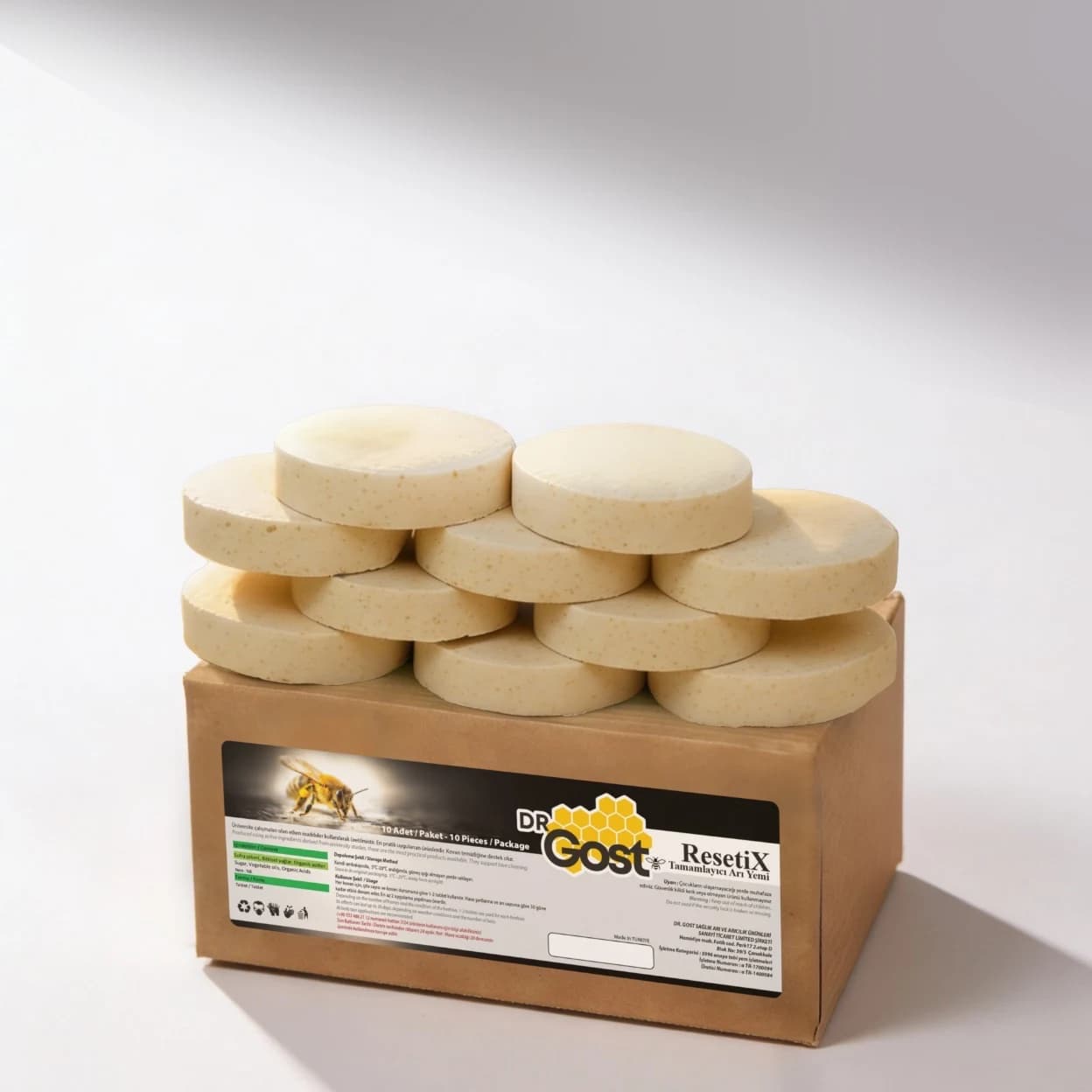
2. Solid reserve: tablets. Resetix, Fullix and Bionix — the contents are held in hard sugar and go directly on or between the frames, without mixing any syrup.
3. Solid reserve: the fondant above, roughly 2 kg.
4. Early spring: a pollen cake. See the end of this page.
Through the winter the colony eats in order: the honey first, then — if it needs to — the tablets and the fondant. The reserve exists so that the day it needs them is not a problem.
⚠️ This is not the same thing as an emergency measure. Fondant on the top bars after you discover a colony is too light is a rescue, and by then the winterising went wrong — that is covered in Winter Feed for Bees. What this page describes is a reserve placed ahead of time, on top of a colony that was already wintered properly. Solid feed does not repair a winterising that never happened.
Why no heat
Two reasons, pointing the same way.
Boiled sugar forms HMF, which is toxic to bees. It is the same reason sugar solution must not be boiled — there about 50 °C is plenty, and here no heat is needed at all.
And Vipo contains live probiotic cultures. Those should not be heated. The same caution applies to Bion in the syrup, for exactly the same reason.
So: cold or barely lukewarm paste, never warm.
Why solid feed, and why on top of the frames
Below about ten degrees the bees go stiff. They have no time to deal with syrup — it has to be carried in, the water driven off and the cells capped — and syrup also adds moisture to the hive, where damp makes the cold worse. That is when solid feed is right.
It is also why the paste goes on top of the frames rather than into a feeder: the only feed that counts in November is feed the bees can reach without leaving the warm cluster.
And that is why we do not open it again. Every inspection in November or December costs the colony heat it cannot afford to replace.
Do not knead your own pollen into it
There is a temptation to mix your own pollen into the paste, since protein is exactly what the paste lacks. Do not.
Pollen from an unknown source can carry infection into the colony, and it is the same reason you must not winter on another beekeeper's honey. The industrial pollen pastes solve it on the production side: Lustgården's product page for Candipolline Gold, made by Enolapi in Italy, states outright that the pollen is gamma-sterilised so as not to spread infection. That is a production step a kitchen does not have.
The same page also confirms what is written further up this one: according to the manufacturer the pollen has to be mixed into a cold paste, or the effect of the vitamins and protein is lost. Cold paste is therefore not our own idea — it is how this kind of feed is meant to be mixed, and a manufacturer in the trade says the same.
In our own method the question does not arise: the protein in Vipo is vegetable, not bee pollen.
Keep foderdeg and pollen cake apart
This is the commonest mix-up, and it decides whether the colony makes it through spring.
- Foderdeg is carbohydrate. Energy. It keeps the colony alive.
- Pollenkaka is protein. It is what brood is built from.
A colony can have plenty of foderdeg and still stall, because it has no protein. The full run through the words is in Beekeeping in a Nordic Climate.
Early spring is the dangerous time
This is where the reserve often falls short, and it is worth saying plainly: starvation comes in spring, not midwinter. The colony has got through the cold on its store, and then the queen starts laying again. Brood costs feed, and brood costs protein — and that is exactly when the store is thinnest.
That is why Winter Feed for Bees says a colony on a single box has to be watched closely for a food shortage in March and April, and why Winter Preparation in a Nordic Climate says to heft the hives from the back in late February.
Our own rule: as soon as the temperature goes above 13 degrees, we lay in a pollen cake. Thirteen degrees is not a biological threshold but a practical one — it is when the hive can be opened without costing the colony too much heat.
Bees do not raise brood on sugar. Brood is built from protein, and the protein comes from pollen. And pollen is what the bee goes looking for outside: cold stops the flight muscles — muscle potentials fall towards zero around ten degrees and chill coma sets in at about 10.6 °C (Hosler et al. 2000) — and because the bee has to warm its thorax to roughly 30 °C before it can lift, the lowest temperature at which bees genuinely fly and get home sits higher, around 12–13 degrees. A bee that flies out in the margin between the two does not always come back.
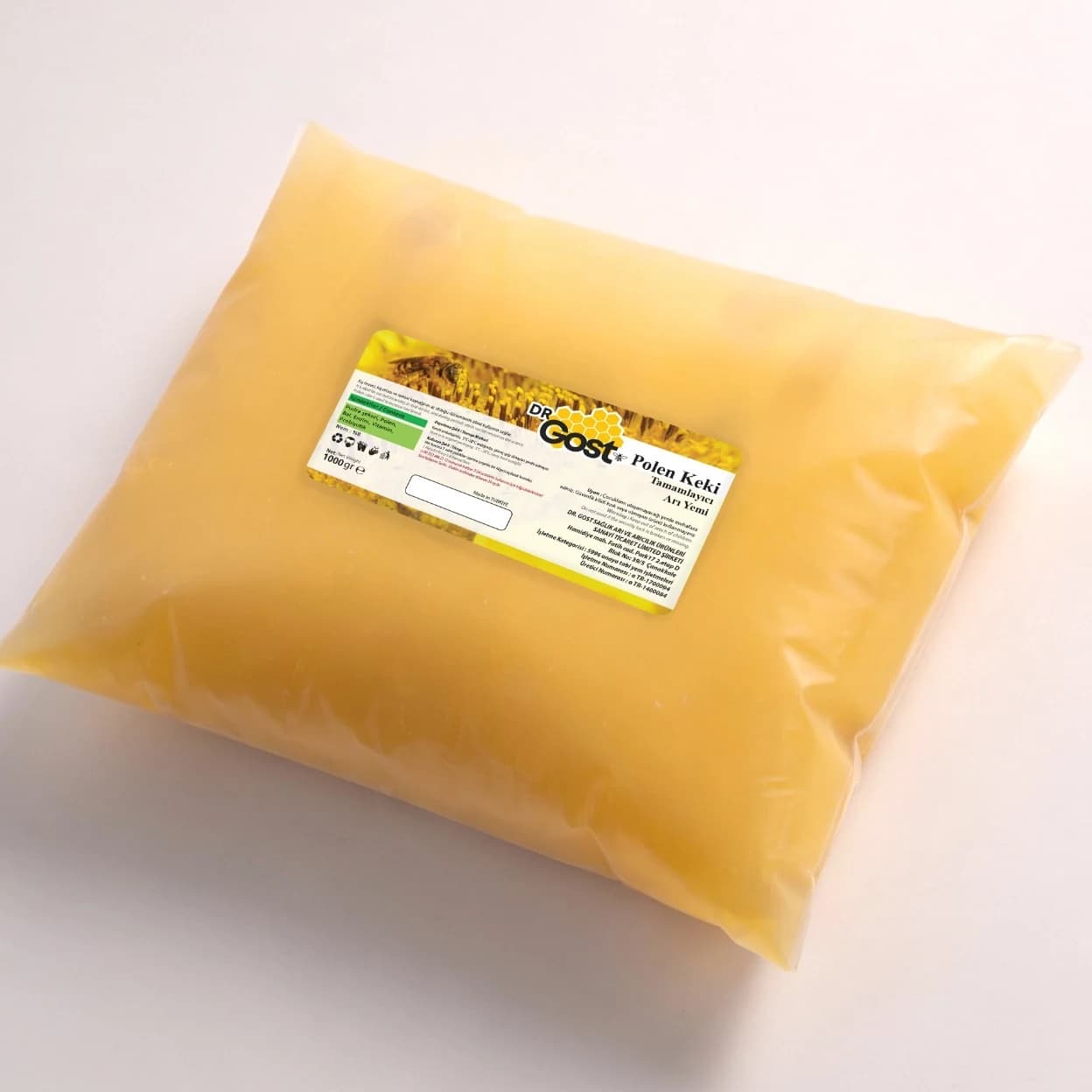
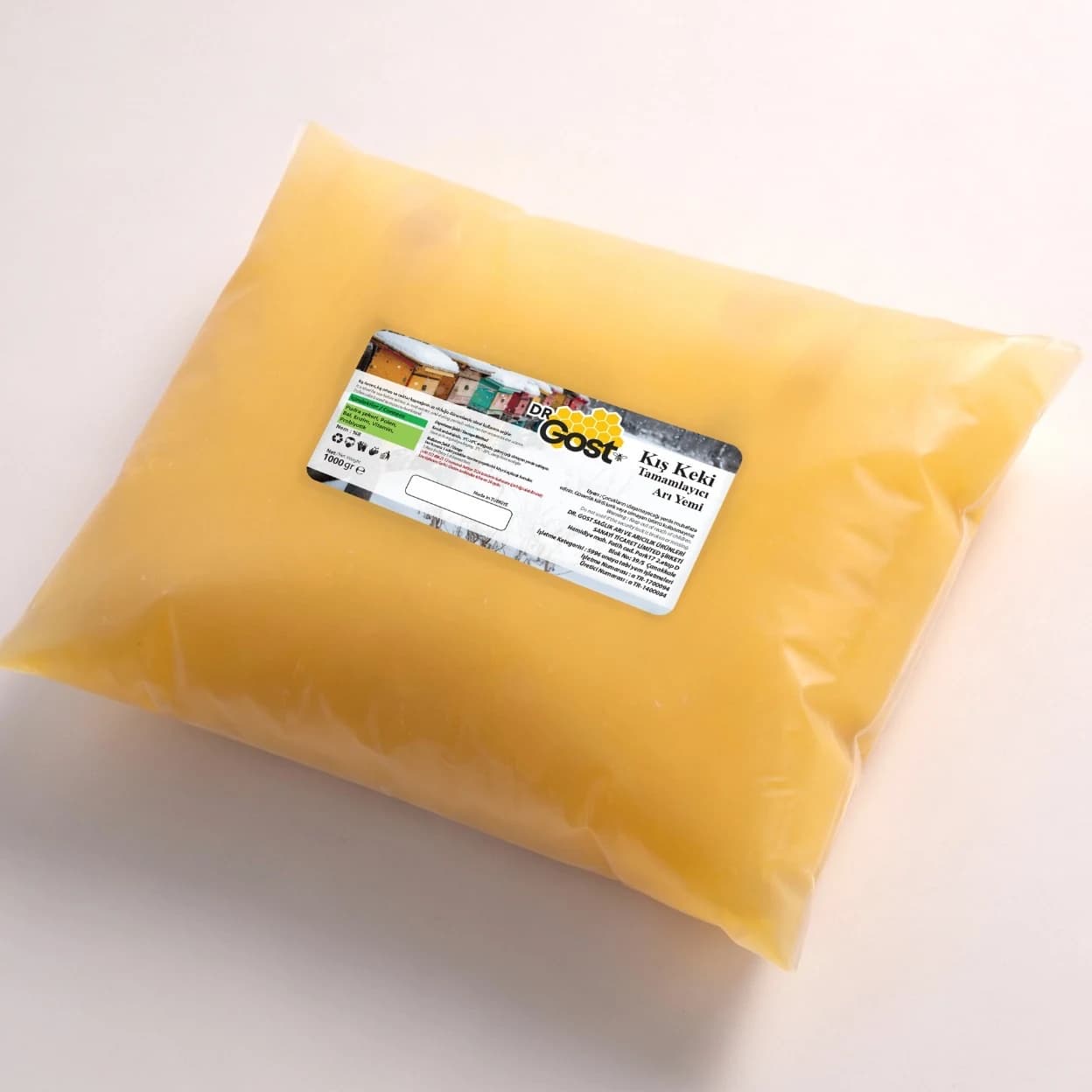
So we put what the colony needs inside the hive instead of letting it be fetched outside. We give a Special pollen cake — pollen, icing sugar, vitamins, enzymes and probiotics, with a high pollen share. There is also a Winter pollen cake formulated for the winter cluster.
The whole spring sequence — drivfoder, stödfoder and where each belongs — is in Spring Build-Up and Stimulative Feeding.
Frequently asked questions
How do you make foderdeg for bees?
You do not cook it. Buy ready-made fondant, let it stay cold or barely lukewarm, sprinkle in a probiotic powder at about 2 g per kilo, knead it through by hand or in a dough mixer, roll it to roughly 1.5 cm and lay it between thin paper on top of the frames. We put on about 2 kg per hive at the start of November and do not touch it until spring.
Should foderdeg be heated or boiled?
No. Boiled sugar forms HMF, which is toxic to bees — the same reason sugar solution must not be boiled. And a probiotic powder contains live cultures that should not be heated. Cold or barely lukewarm paste, never warm. The same rule appears on the industrial pollen pastes: the manufacturer of Candipolline Gold states the pollen must be mixed into a cold paste or the vitamins and protein lose their effect.
When should foderdeg go on, and where?
On top of the frames, directly over the cluster, at the start of November. Below about ten degrees the bees cannot deal with syrup — it has to be carried in, evaporated and capped — and syrup adds moisture to the hive. The only feed that counts then is feed the bees can reach without leaving the warm cluster. Every inspection in November or December costs heat the colony cannot replace, so it is left alone until spring.
Is foderdeg the same thing as a pollen cake?
No, and the difference decides whether the colony makes it through spring. Foderdeg is carbohydrate — energy that keeps the colony alive. A pollen cake is protein, and protein is what brood is built from. A colony can have plenty of foderdeg and still stall because it has no protein.
Can you knead your own pollen into the paste?
Better not. Pollen from an unknown source can carry infection into the colony, which is the same reason you must not winter on another beekeeper's honey. The industrial pollen pastes gamma-sterilise the pollen in production, which is a step a kitchen does not have. In our own method the question does not arise: the protein in the powder we knead in is vegetable, not bee pollen.
This is written by a working apiary, not an agency
Buzzin’ Bees is in Svinninge. We sell the honey our own hives make, and the Dr. Gost supplements we bring into Sweden.