Winter Feed for Bees: How Much, When and How to Feed Before the Cold
By Adam M Akkemik — beekeeper in Svinninge · Jordbruksverket registered · Biodlarna Stockholm member
Winterising decides the winter. How many kilos of winter feed a normal colony needs, why you start straight after the final harvest, why thin syrup in September is a mistake, which feeder to use — and when to stop.
Winterising is the most consequential thing a beekeeper does all year, and it happens over a few weeks in August and September. Almost everything else can be done again next season. A colony that goes into winter short of stores — or with feed the bees never got down and capped — does not get a second attempt.
This article is about the feeding half: how many kilos a colony needs, when you start, what you give, how you give it, and when you stop. The rest of winterising — mouse guards, ventilation, the queen, varroa — is in Winterising Hives in the Nordic Climate.
The Swedish words, because they decide what you find
If you search in Swedish you will meet six words, and they are not interchangeable.
Invintring is the whole autumn preparation: the final harvest (slutskattning), the varroa treatment, and the winter feeding. It is a verb as well as a noun — a beekeeper says they are going to invintra their colonies.
Bifoder is anything you give the colony that did not come from the flow: sugar solution, ready-mixed feed, candy.
Vinterfoder is the bifoder that has to last from October to May.
Sockerlösning is the sugar solution itself, and sockerlag is the same thing in the word most product labels use.
Invintringsfoder is the heavy autumn ration meant to be stored — another word for vinterfoder, and the one the shops use as a category name.
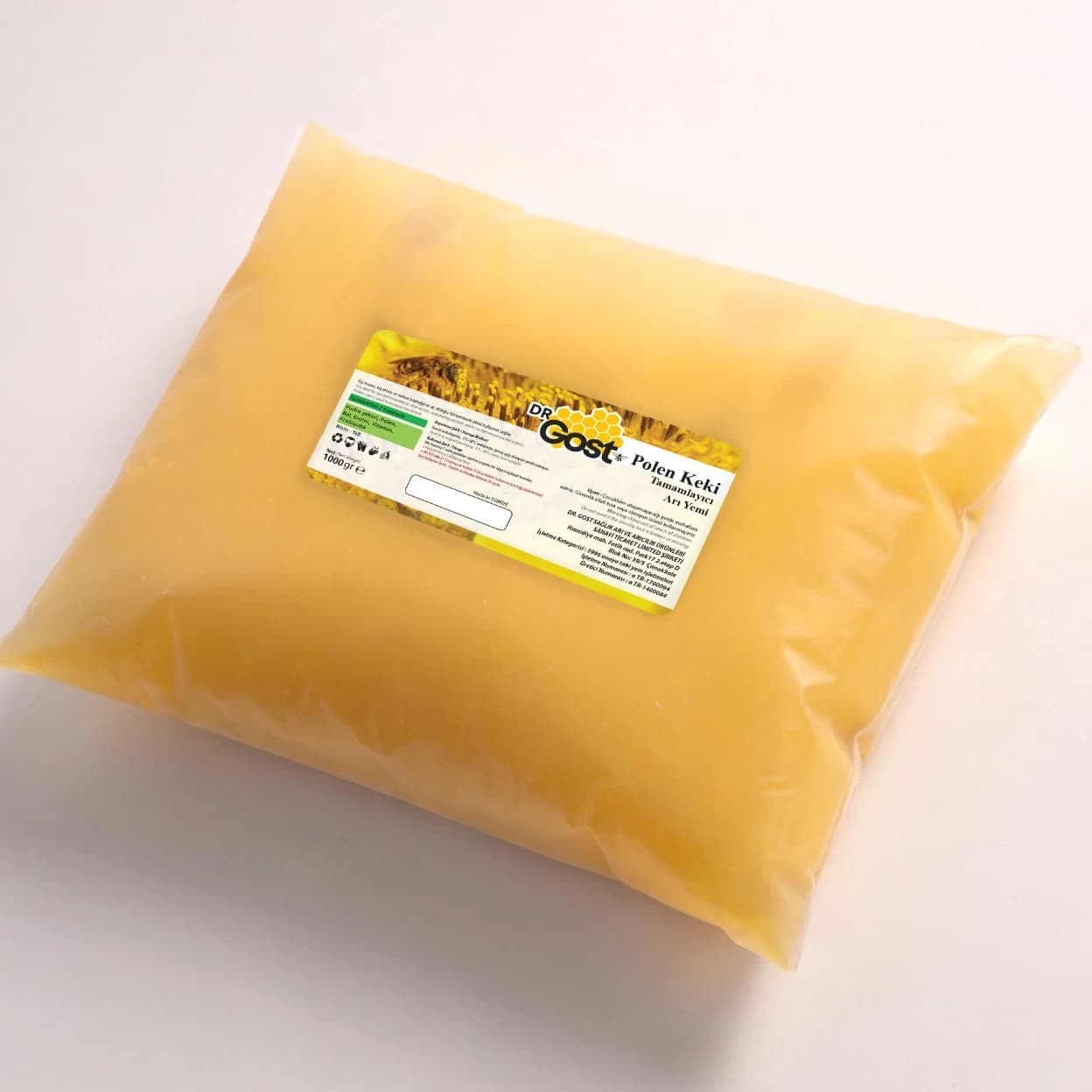
Foderdeg is the solid feed, the paste in a bag; on the shelf it is called Ambrosia, Neopoll or Candipolline. In autumn it is a supplement to the ration rather than the ration itself. It gives energy, but it is not taken down and stored in the combs the way a 60 % solution is, so it weighs little when you count kilos. Its moment comes later, from November onwards, and then as an emergency measure.
How much winter feed does a colony need?
In kilos, and counted against what is already in the hive.
- A normal-strength colony: around 20 kg of winter stores, including the honey you leave behind. That is how alltombiodling.se puts it, and it is the number most Swedish beekeepers work towards.
- Biodlarna, the Swedish beekeepers' association, give a floor of at least 15 kg of sugar. A floor, not a target.
- 20–25 kg if the colony is wintered on two boxes. That is the figure from Mariestads biodlarförening, who also note that many beekeepers therefore give one and a half buckets of Bifor — around 18 kg — on top of the capped honey frames already in the brood chamber.
- On a single box, roughly 16–18 kg is enough, but then you have to watch that colony far more closely for a food shortage in March and April.
Subtract what is already there. A Swedish LN frame full of capped honey weighs about 2 kg; an HLS frame about 1 kg. Six full LN frames is therefore around 12 kg — and the number you owe the colony is the remainder, not another twenty.
And do not fill the box. The bees need empty cells to sit in for the winter cluster to work. A colony fed until every cell is full has been given food and has lost its winter quarters.
Timing is half the job: start straight after the final harvest
This is the expensive mistake, and it is not about quantity. It is about the date.
The bees do not simply receive the feed. They have to carry it down, evaporate the water out of it, invert the sugar and cap the cells. That work needs warmth and it needs time. Mariestads biodlarförening put it plainly: winterise early, both so the bees have time to store the feed where they want it, and because it is far easier for them to bring the water content down to around 20 % while it is still warm outside. From the middle of September the nights are usually too cold for that.
So: take the last harvest off, treat for varroa, and start feeding. In central Sweden that means the feeding should be finished during September. Feed in October and you have handed the colony a bucket of liquid it can do nothing useful with.
There is a second reason not to wait. Right now the queen is laying the bees that will live through the winter — the vinterbin, which live five to six months rather than a few weeks. They should be raised in a colony that has food and pollen, not in one that is waiting on the beekeeper.
Why thin syrup in September is a mistake
Two different solutions with two different purposes get mixed up constantly.
Thin syrup — roughly equal parts sugar and water — is stimulative feeding, what Swedish beekeepers call drivfodring. It belongs to spring, in small amounts, and its message to the colony is that a flow has started.
Winter feed is thick. The Swedish standard is a 60 % sugar solution: three parts sugar to two parts water, by weight. That is the mix alltombiodling.se and most Swedish associations specify for invintring.
Give thin syrup in September and you are asking the colony to evaporate roughly twice as much water, at the time of year when that is hardest. The consequences are predictable: uncapped feed that ferments, extra moisture in the hive exactly when moisture is the central Nordic problem, and a stimulative signal to a queen who is weeks away from stopping.
Two more things about the mix:
- Do not boil it. Warm water dissolves sugar; around 50 °C is plenty. Boiling forms HMF, which is toxic to bees.
- Use ordinary white granulated sugar. Not raw sugar, not brown sugar, not molasses. They contain residues bees cannot digest, and the result is dysentery (utsot) during a five-month confinement.
Mix your own, or buy it ready-made
Both routes are normal in Sweden. Alltombiodling.se puts a number on each: about 18 kg of sugar per colony if you mix your own, or one and a half buckets of Bifor if you buy it ready-mixed.
The difference that matters is water. A normal sugar solution contains roughly 40 % water. Bifor contains 25 %, because it is an inverted sugar that arrives already mixed — so the bees spend less energy driving water off.
Bifor gets its own article, because what is in the bucket and what is not in the bucket is worth knowing before you pour it: Bifor: What Is Actually in the Bucket.
Sugar syrup mixing table
By weight, because that is how the percentage is defined. A litre of water weighs a kilo, so the water can be measured in litres.
| Mix | Sugar | Water | Makes about |
|---|---|---|---|
| Winter feed 60 % (3:2) | 3 kg | 2 litres | 3.9 litres |
| Winter feed 60 %, 10 litres of finished syrup | 7.7 kg | 5.2 litres | 10 litres |
| Winter feed 60 %, one colony's need | 18 kg | 12 litres | 23 litres |
| Spring stimulative feeding, 50 % (1:1) | 1 kg | 1 litre | 1.6 litres |
The syrup takes up less room than the sugar and the water did separately, because the sugar dissolves into the water: a kilo of sugar adds roughly 0.6 litres.
Vinegar or lemon in the syrup?
An old home trick is to add a splash of vinegar or lemon juice. The acid lowers the pH, and the idea is that the sugar starts to break down — to invert — in the bucket, saving the bees part of the work.
We do not do it. In lukewarm syrup very little happens in the days it takes the bees to take the feed down, and heating the syrup with acid to speed it up forms HMF — the same compound that makes boiled syrup toxic to bees. The bees invert the sugar themselves, with the enzyme invertase. That is the work that needs warmth and time, which is why the date, not the recipe, decides the winterising.
How we mix it
Once the syrup has cooled we stir in three complementary feeds from Dr. Gost, about 2 dl of each per 10 litres of syrup:
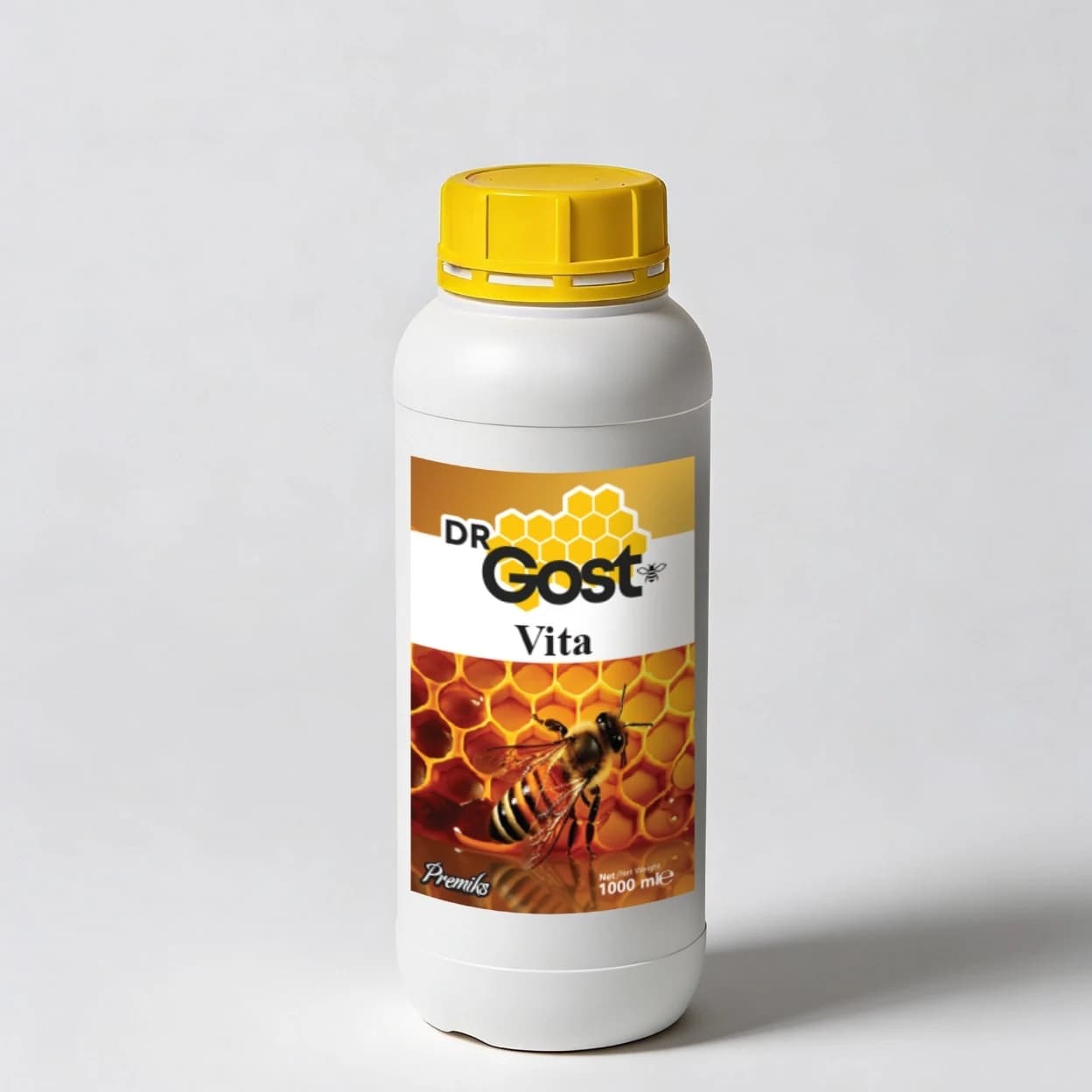
- Vita — vitamins and amino acids in liquid form.
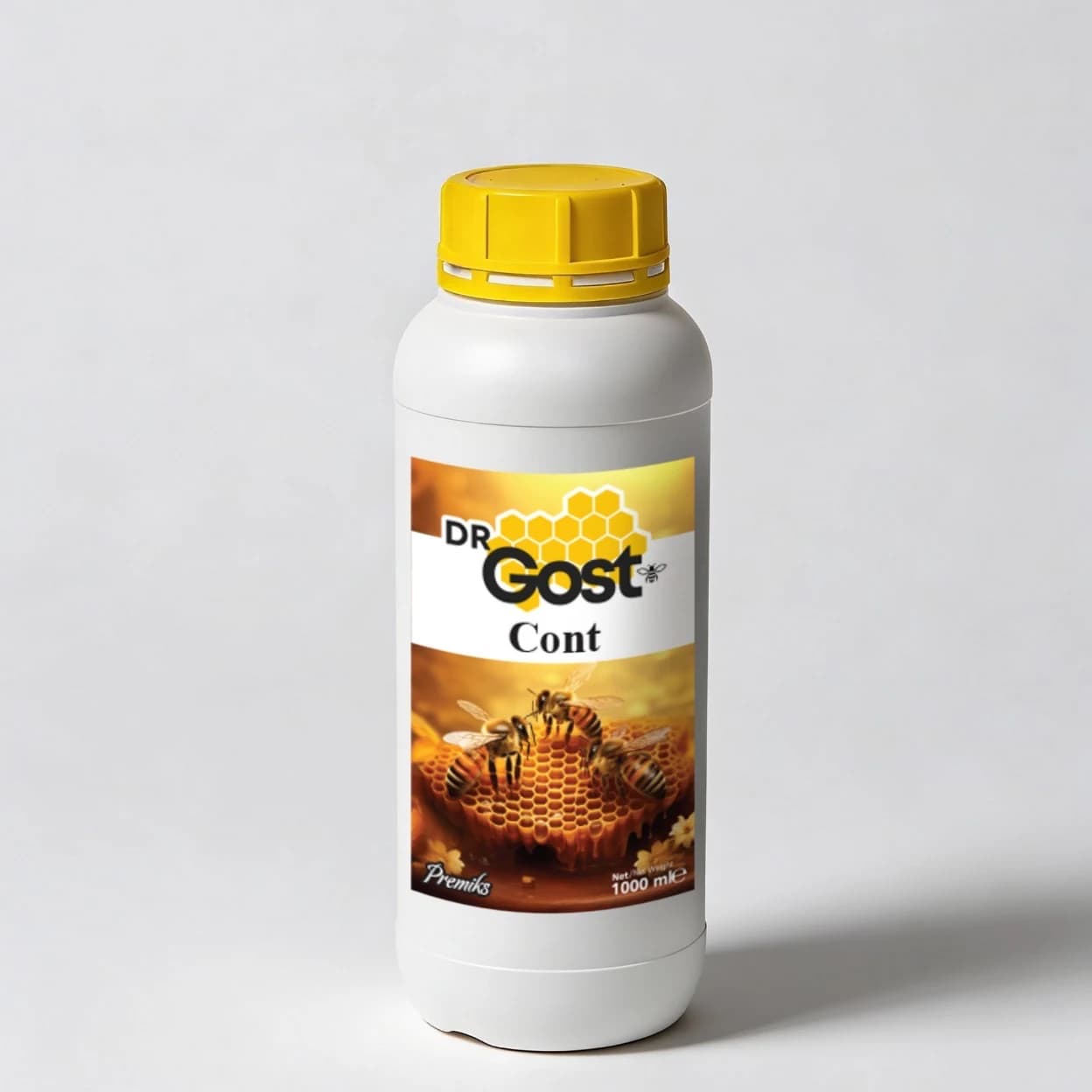
- Cont — digestive enzymes that speed up the bees' digestion, so the colony takes down large amounts of feed faster.
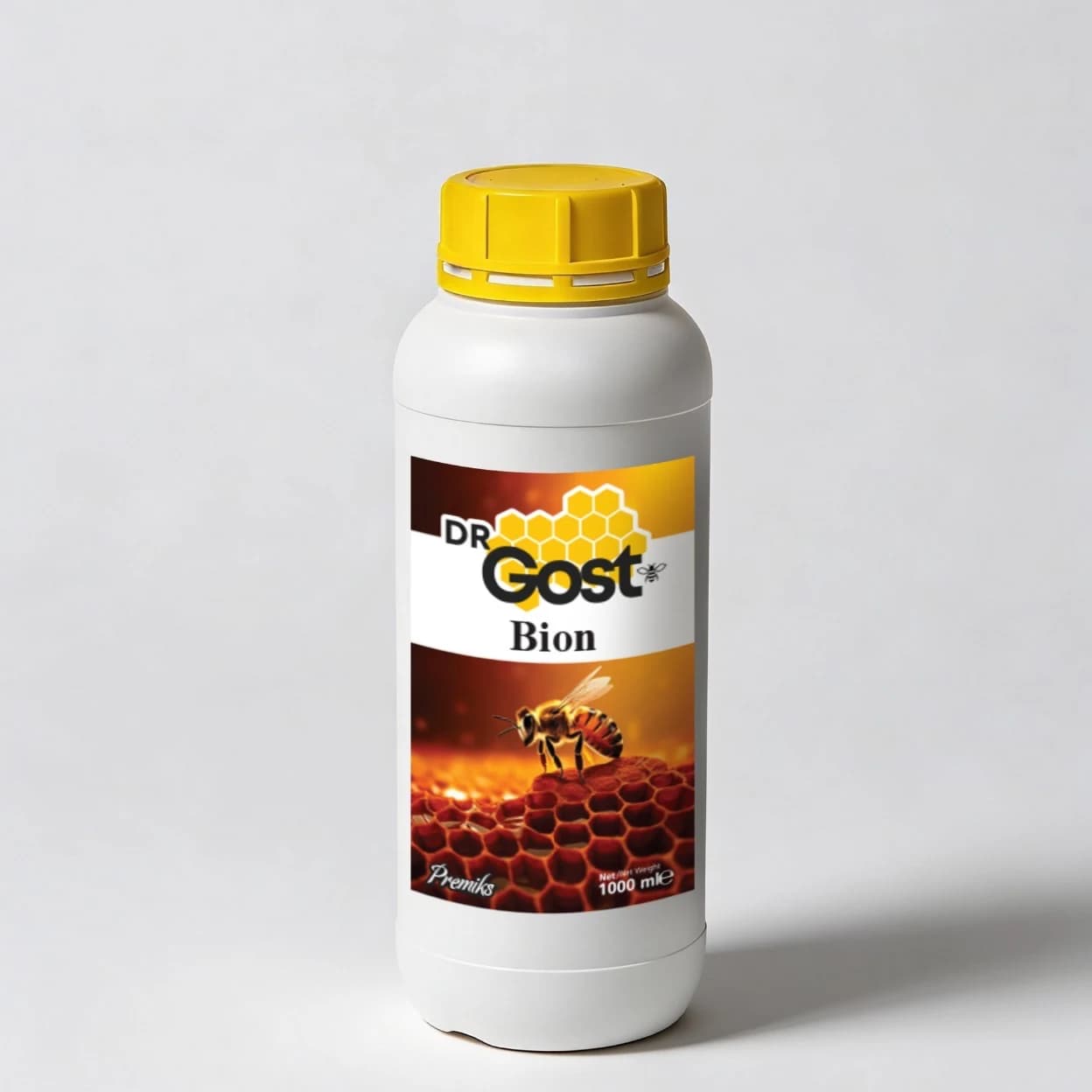
- Bion — probiotic cultures for the gut flora.
That is 20 ml per litre of each, within the labels' 10–25 ml. Wait until the syrup is lukewarm: Bion contains probiotic cultures, and they should not be heated.
None of this replaces anything above: the supplements do not turn thin syrup into winter feed, and they do not move the date. What they do is a different job. Plain sugar is carbohydrate and nothing else, while a winter bee has to be built from more than that — Vita brings vitamins and amino acids, and Bion and Cont the gut flora that has to handle fifteen kilos of feed in a few weeks. That is why they go in while you are feeding anyway, rather than instead of feeding correctly.
Feeders
The feeder matters less than the timing, but it decides how much you can give at once and how often you have to open the hive.
- Feeder bucket or plastic feeder (foderhink, plastfodrare) over the hole in the crown board. Holds a lot. A Bifor bucket has a perforated lid, so the packaging is the feeder.
- Feeder box (foderlåda) — an empty super with a trough in it. The largest volume and the fewest openings; also the heaviest thing you will carry that month.
- Feeder bag or balloon (foderpåse, foderballong) — cheap and simple, good for smaller doses.
- Frame feeder (ramfodrare) replacing a frame in the brood chamber. Good for weak colonies and nucs, and lower robbing risk. Make sure there is a float or mesh inside or the bees drown.
Give large doses to strong colonies. Every extra opening in September costs the colony heat and costs you the chance of starting a robbing frenzy.
Robbing is the other autumn risk
Several colonies being fed in one apiary is an invitation. Reduce the entrances, do not spill syrup on the ground or down the side of the hive, cover exposed frames, and work fast. A weak colony robbed out in September does not die in September. It dies in February.
Honey you should not winter on
If you are wintering wholly or partly on honey frames, avoid heather honey and honeydew honey (ljunghonung, bladhonung). Both raise the risk of dysentery over a long confinement. Take them off and give sugar solution instead.
And one rule with no exceptions: sugar solution must never be given to a hive with supers on that are intended for harvest. That produces false honey, and it is the fraud that damages every honest beekeeper's market.
What never goes in the feeder
- Honey from an unknown source. Shop honey and honey from other beekeepers can carry American foulbrood spores. The spores survive in honey for decades, and one jar can cost you the apiary. It is illegal to feed in Sweden for exactly that reason.
- Raw sugar, brown sugar, molasses.
- Juice, soft drinks, anything else sweet.
Sugar is not pollen
Sugar solution is energy. Protein comes from pollen, and no winter feed replaces it. Protein is what builds the fat body in the winter bees, and the fat body is what decides whether they last five months. The amino acids in Vita do not change that: a supplement in the syrup is not a pollen reserve.
The pollen reserve in the combs is part of winterising too, and it is the part you cannot pour out of a bucket. The protein side of the year, and the spring pollen gap, are covered in Spring Build-Up and Feeding After Winter.
A colony's nutritional needs are more than kilos
Winterising is counted in kilos, but the kilos are one line in the colony's nutritional needs. A colony facing a Nordic winter needs four things, and the winter feed covers one of them:
- Energy. Carbohydrate to burn for warmth. That is what the sugar solution is, and the only line you can weigh out and pour in.
- Protein. Pollen, which builds the fat body in the winter bees. It cannot be fed in during September — it has to be in the combs already.
- Vitamins, minerals and amino acids. Small amounts, but they come with the honey and they leave when the honey is replaced by plain sugar.
- Water. The bees need it to use feed that has crystallised in mid-winter, which is the same time of year they cannot fly for it.
Reading the nutritional need as a weight alone is the commonest reason a heavy colony still goes into spring weak.
Colony health in March is decided in the weeks you winterise
The winter bees hatch in August and September — the same weeks winterising runs. A colony raising its winter bees under heavy mite pressure gets bees with shorter lives, however many kilos you weigh in. That is why the order is final harvest, treatment, feed, and not the other way round. The treatment side is in Varroa Mite Control: Approved Methods in Sweden.
Supplements belong in that picture, but in their place: our Dr. Gost products are complementary feed under Regulation 767/2009, not medicines. They replace neither the mite treatment nor the kilos in the hive, and we do not write that they do.
When to stop
When the weight is in and the feed is capped. Heft the hive from the back and learn what a properly winterised colony feels like in your hands — that is the measurement you will be making in February, in the dark, without opening anything.
After that, liquid feed is no longer an option. From November onwards it is a candy block or fondant on the top bars, and that is an emergency measure rather than a plan.
The supplements from the syrup also come in solid form, pressed into tablets that are given without mixing any feed: Vitax is the solid Vita, Bionix the solid Bion, and Ultrax the two together.
An emergency can reach a well-fed colony too: honey that has crystallised in the combs is hard for the bees to use in a hard frost, because they need water to dissolve it. So we put the tablets in the hive next to the candy before winter closes the colony in, so they are there if it comes to an emergency — one or two per hive, as the label says.
See it in practice
English audio · Swedish & Turkish subtitles
The video loads from YouTube (Google) when you press.
The autumn recipe for one bucket
The film has no sound, and its on-screen text is in Swedish. What it says:
Recipe for one bucket: 12.5 kg of sugar syrup, Bifor or home-made. Into the syrup, in this order: 1. Bion +200 ml, 2. Cont +200 ml, 3. Vita +200 ml, 4. Vipo +25 g. In the hive: Resetix, 1–2 tablets. Keeping the bees content is our debt to nature.
Frequently asked questions
How much winter feed does a colony need?
Around 20 kg of winter stores for a normal-strength colony, counted including the capped honey you leave behind. Biodlarna give a floor of at least 15 kg of sugar; Mariestads biodlarförening put a two-box colony at 20–25 kg, and a single box needs roughly 16–18 kg but then has to be watched closely for a food shortage in March and April. Subtract what is already there — a full LN frame of capped honey weighs about 2 kg.
When should you feed for winter?
Straight after the final harvest, which in practice means August or September depending on where in the country you are. The bees have to carry the feed down, evaporate the water out of it, invert the sugar and cap the cells, and that work needs warmth and time — which is why the date matters more than the quantity.
How strong should winter syrup be?
Thick. The Swedish standard for invintring is a 60 % sugar solution — three parts sugar to two parts water, by weight. Thin syrup, roughly equal parts sugar and water, is stimulative spring feeding (drivfodring): given in September it asks the colony to evaporate about twice as much water at the hardest time of year, and the result is uncapped feed that ferments and extra moisture in the hive.
Can you boil the sugar solution?
No. Warm water dissolves sugar and around 50 °C is plenty; boiling forms HMF, which is toxic to bees. Use ordinary white granulated sugar — not raw sugar, brown sugar or molasses, which contain residues bees cannot digest and cause dysentery over a five-month confinement.
Should you add vinegar or lemon to the sugar syrup?
It is an old home trick: the acid lowers the pH, and the idea is that the sugar starts to break down — invert — in the bucket. In lukewarm syrup very little happens in the days it takes the bees to take the feed down, and heating the syrup with acid to speed it up forms HMF, which is toxic to bees. The bees invert the sugar themselves with the enzyme invertase, which is why when you start feeding matters more than what you mix in. We do not add vinegar.
Can you feed shop honey or honey from another beekeeper?
No, and it is illegal to do so in Sweden for exactly this reason: honey from an unknown source can carry American foulbrood spores, the spores survive in honey for decades, and one jar can cost you the apiary.
Does sugar solution replace pollen?
No. Sugar solution is energy; protein comes from pollen, and no winter feed replaces it. The protein is what builds the fat body in the winter bees, and the fat body is what decides whether they last five months.
This is written by a working apiary, not an agency
Buzzin’ Bees is in Svinninge. We sell the honey our own hives make, and the Dr. Gost supplements we bring into Sweden.