Bifor: What Is Actually in the Bucket, and What Is Not
By Adam M Akkemik — beekeeper in Svinninge · Jordbruksverket registered · Biodlarna Stockholm member
Most Swedish beekeepers winter their colonies on Bifor, and so do we. What it is, why the 25 % water figure matters, how the bucket arithmetic works, what a ready-made inverted sugar does not contain — and what our labels say about adding to it.
If you keep bees in Sweden, the odds are you are feeding Bifor right now. We are too — it is what goes into our own hives at Svinninge, and this article is not an argument against it. It is an account of what is in the bucket, because a beekeeper standing over an open feeder in September is entitled to know exactly what they are pouring.
What Bifor is
Bifor is a ready-made winter feed. Alltombiodling.se describes it in one line: it contains inverted sugar, which honeybees do not have to break down in the gut, and it arrives already mixed so the beekeeper does not have to make up their own sugar solution.
That is the whole product, and the whole appeal. It is sold through the beekeeping suppliers and their resellers, in buckets and loose by weight, and the bucket has a perforated lid so the packaging doubles as a feeder.
The manufacturer is Nordic Sugar, as printed on the bucket. This is not a home-brewed mix but an industrially produced feed from one of the largest sugar producers in the Nordics — worth knowing before the rest of this article reads as criticism. It is not.
The number that actually matters: 25 % against 40 %
The interesting figure is not the sugar. It is the water.
Bifor contains 25 % water. A normal home-mixed sugar solution contains about 40 %. That comparison is alltombiodling.se's own, and it is the reason the product exists: the bees spend less energy driving water out before they can cap the cell.
In September, that is not a convenience — it is the constraint. The bees have to get the water content down to roughly 20 % before they cap, and they have to do it while the nights are still warm enough for the evaporation to work. Every percentage point of water you hand them is work you are asking for in the weeks when they have the least time to do it.
The bucket you are probably holding
The common pack is a 12.5-litre plastic bucket, which the sellers list and price by weight as 12.5 kg. Biredskapsfabriken in Töreboda sell it as article number 218-9, listed at 216.80 kr each, and also by the pallet of 44 and in larger lots. Their own description reads, in full:
"För rationell och snabb invintring! Färdig sockerlösning i 12,5 kg's plasthink med perforerat lock avsett för ett samhälle. God hygien. Rationell hantering. Låg vattenhalt. Säkrare övervintring."
In English: for rational and rapid winterising, a ready sugar solution in a 12.5 kg plastic bucket with a perforated lid, intended for one colony. Good hygiene. Rational handling. Low water content. Safer overwintering.
The price was read on 3 September 2026, and the sugar products in their range carry an asterisk and are sold at the day's rate — so confirm the price when you order.
One part of that description is the seller's claim rather than ours: "Låg vattenhalt. Säkrare övervintring" — low water content, safer overwintering. We report it as theirs. We do not repeat it as ours, for the reason set out at the foot of this page.
The phrase worth stopping on is "avsett för ett samhälle" — intended for one colony. That one can be checked, and the check is not written down anywhere else.
What one bucket contributes
Follow the arithmetic, so you can see where the number comes from.
The water content is 25 %, per alltombiodling.se. That leaves roughly 75 % dry matter — the sugar that stays in the cell once the bees have driven the water off. On a 12.5 kg bucket that works out at roughly 9.4 kg of stored feed. It is an estimate rather than a measured figure, and it stands or falls on those 25 % holding true for your bucket.
A cross-check from a different direction: Mariestads biodlarförening reckon on a 16 kg bucket and get about 12 kg of stored feed once the bees have capped it. Precisely the same ratio — three quarters — arrived at by someone counting real frames rather than reading a declaration. Two independent routes to the same figure is as close to confirmation as you get without your own scales.
And here is what makes the number useful: a bucket is a top-up, not a full winter ration. The roughly 20 kg a normal colony wants is the total — capped honey on the frames plus what you feed. You never give a bucket to a colony sitting on nothing. You give it to a colony that already has honey, and the bucket takes it the rest of the way. Read like that, "intended for one colony" is exactly what it should be: a normal autumn dose for a normal colony.
So count the frames before you order, not after. An LN frame full of capped honey weighs about 2 kg, an HLS frame about 1 kg. Six full LN frames is around 12 kg, and one bucket on top lands you near 21 kg — which is precisely where you want to be. If the colony is thinner than that, you know in August that it needs more than one bucket, and that is a very different thing from finding out in March.
From our own apiary: we gave one bucket per colony at Svinninge last season and it was entirely sufficient. That is what we did and how it went — not a promise about how it will go for you. Your forage, your frames and your site decide.
Pack sizes differ between sellers, so read the weight on your own bucket rather than ours. The method is the point, not the number: work out the total in kilos of stored feed, subtract what is already on the frames, and buy the difference.
The feed does two jobs at once
This is the part that usually goes missing, and it explains why the timing matters so much.
A colony fed in August reads that feed as a flow. The queen keeps laying, and that generation is the winter bees — the ones that have to live five or six months rather than a few weeks. So the feed is not only filling a store. It lands in the middle of the weeks when the colony is still raising brood.
That is also why the rule about starting straight after the final harvest is more than a convenience, and why thin syrup late in September is the right thing at the wrong moment. Winter Feed for Bees takes that side of it.
And it is worth reporting what alltombiodling.se note about winter bees: they are best raised on nectar and pollen from nature rather than on sugar solution. Sugar is energy. Brood is built from protein.
Which makes what the colony has to eat during exactly those weeks a nutrition question. And that puts the next question where it belongs: what is actually in the bucket.
What Bifor does not contain
Here is the part nobody writes down, and it is not a criticism.
Bifor is sugar and water. The description names two things — inverted sugar, and a 25 % water content. There are no vitamins in it. No amino acids. No protein. No probiotics and no prebiotics. It is a carbohydrate, delivered efficiently, which is precisely the job a winter feed is bought to do.
Check your own packaging, because the label on the bucket is what governs. But that is what a ready-made invert sugar is, and it is why the question "should I add anything to it?" is a reasonable question rather than a sales pitch.
Who developed them
We import and sell the Dr. Gost range, and it is worth saying where it comes from, because provenance is a fact rather than a claim.
The range was developed and tested by Dr. Soner Güner, who holds a doctorate in beekeeping and has more than twenty years of research behind him. He is the author of Yeni Nesil Doğal Arıcılık — "New-Generation Natural Beekeeping" — described by its Turkish bookseller as the first written work in the country on the subject, and he runs a YouTube channel and an Instagram account of some eighteen thousand followers, both about bees and natural products. This is a range formulated by someone whose profession is the study of bees, not a white-label bought in and relabelled.
It was also formulated for exactly this use. These are not products you have to find a place for in your season: they are made to be added to feeding syrup, which is what their labels direct and what the range is for.
The manufacturer's own product information for Resetix states that its active ingredients derive from university studies. Which university, and which studies, is something we have asked our supplier to document. Until that paperwork is in our hands, we report that sentence as theirs rather than as ours.
What they contain, and what the labels say about dosing
So the compositional picture is plain enough to state without embellishment. Bifor supplies energy and nothing else. These are formulated to supply the vitamins, amino acids and probiotics it does not contain.
Below is what each one declares and what its label says about dosing — the labels, and nothing added by us.
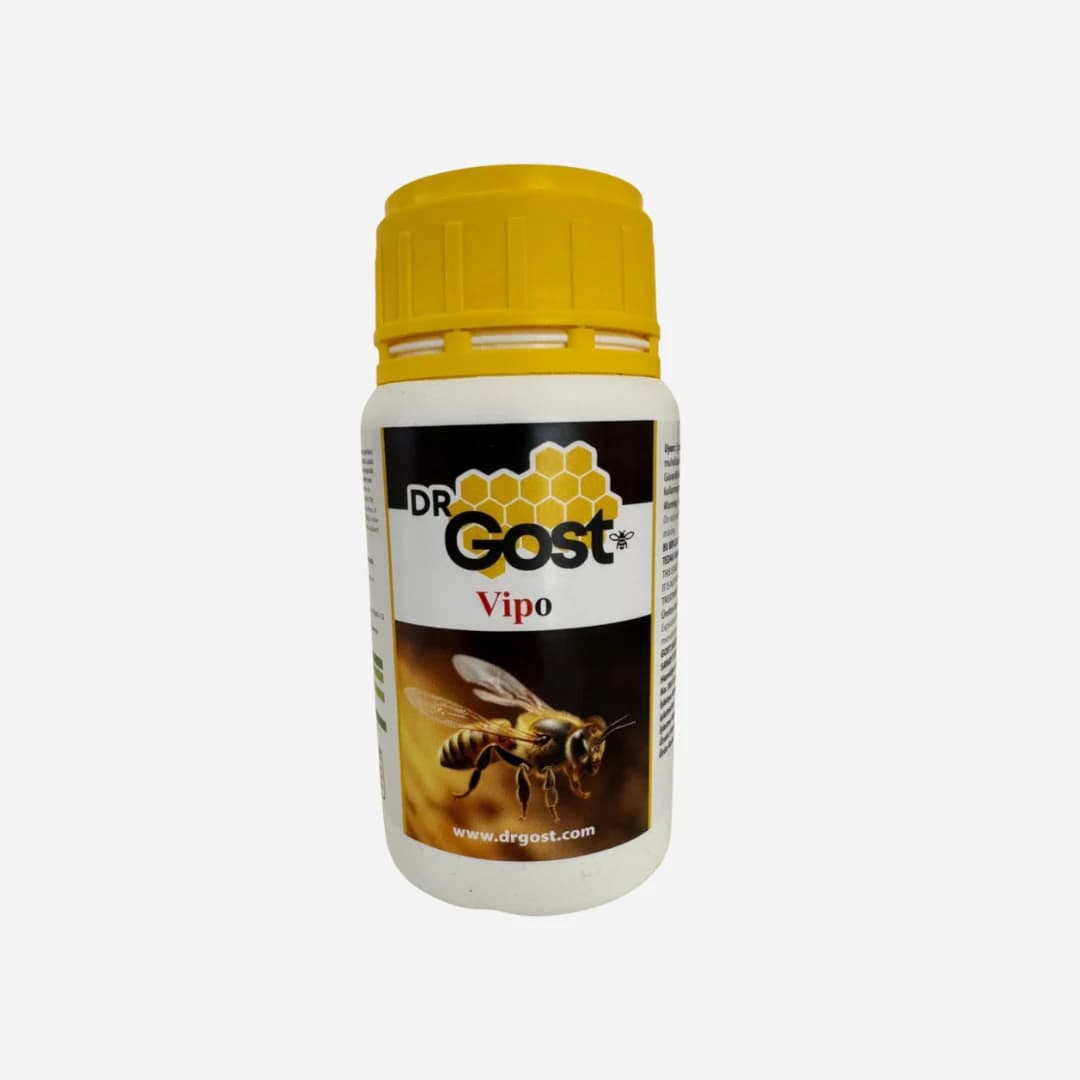
Vipo — a powder. Its declaration lists probiotics, prebiotics, vitamins, protein and amino acids. Dosing: 2 g (1 tsp) per 1 litre of cake or 1 kg of syrup.
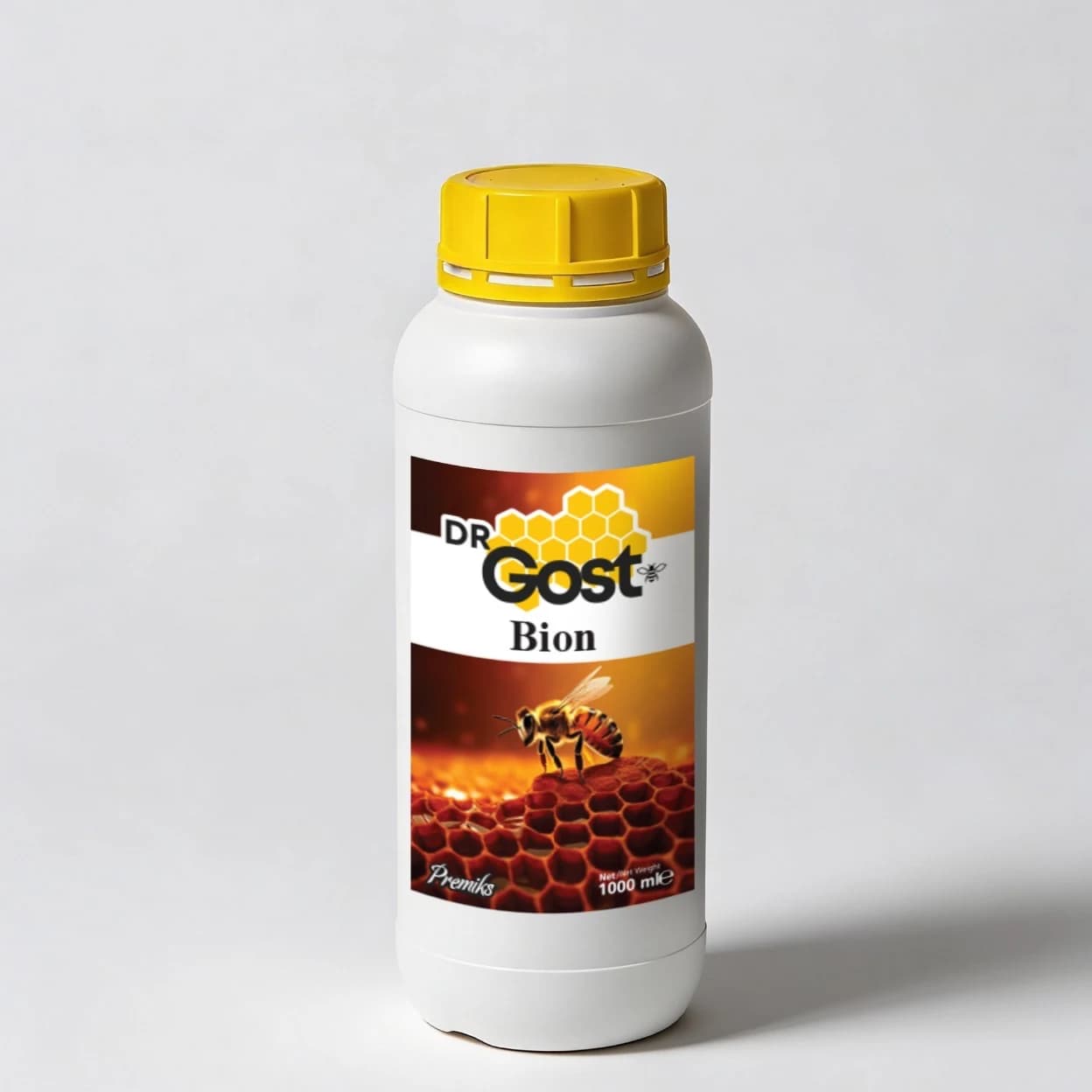
Bion — a liquid. Dosing: add 10–25 ml per 1 litre of cake or syrup.
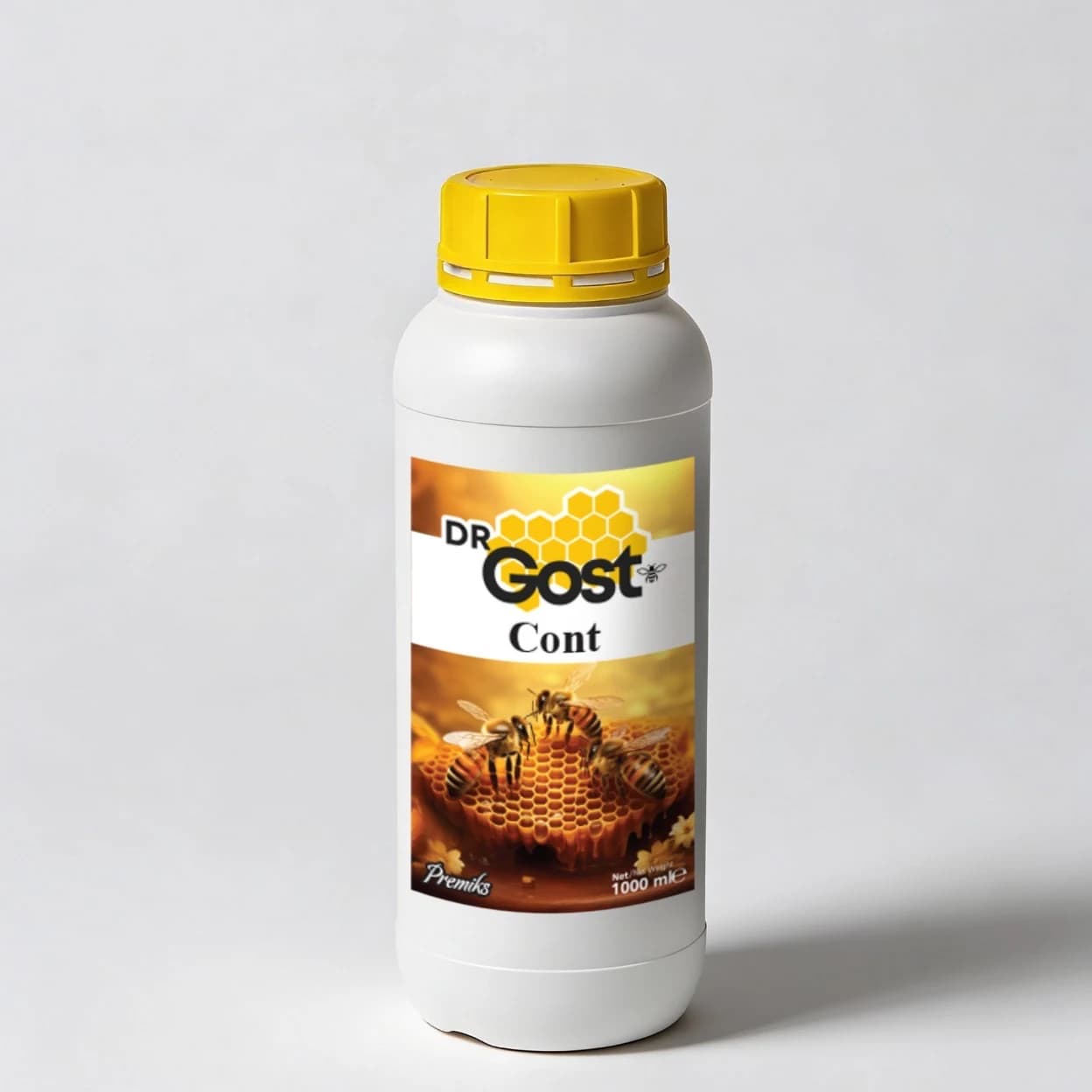
Cont — a liquid. Dosing: add 10–25 ml per 1 litre of cake or syrup.
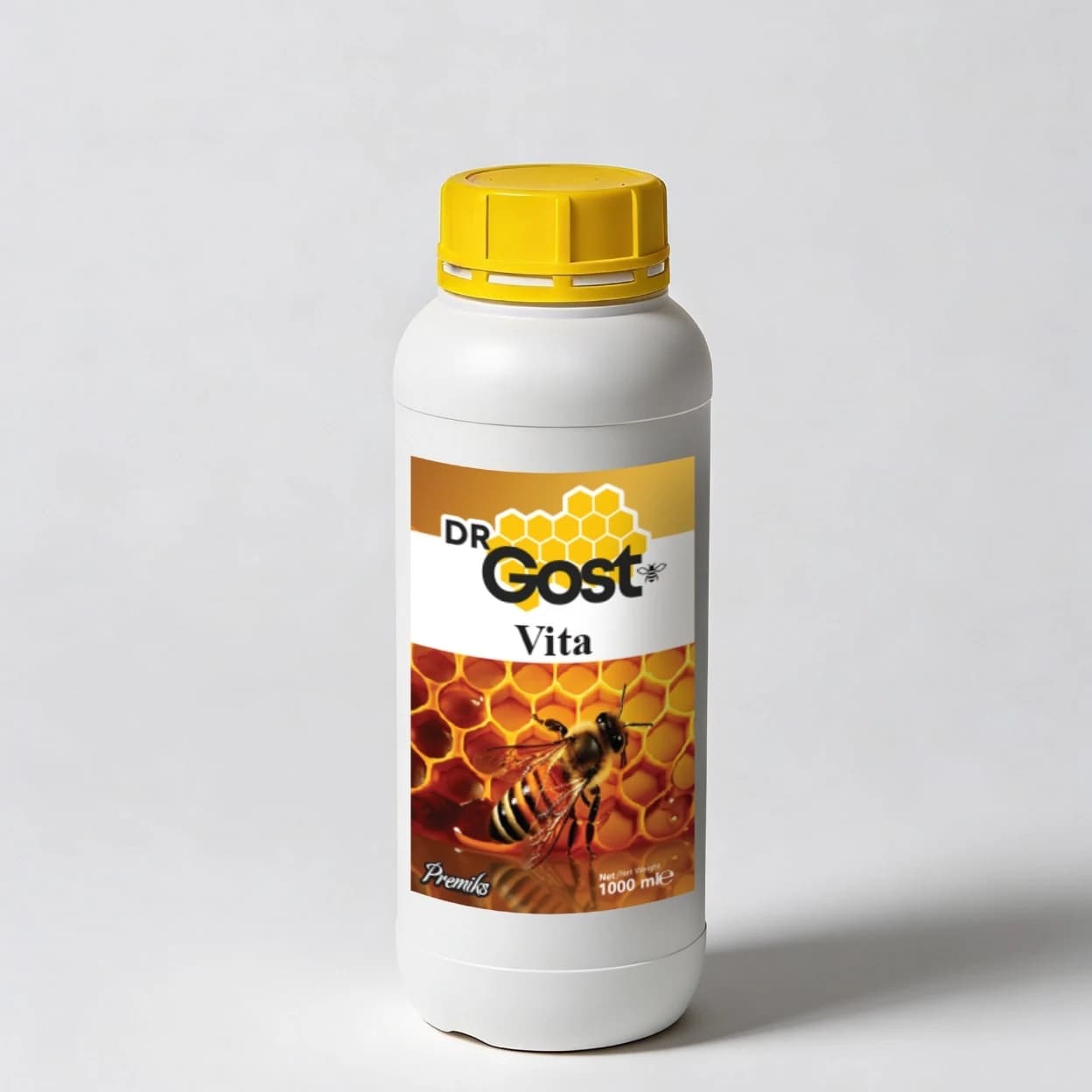
Vita — a liquid. Dosing: add 10–25 ml per 1 litre of cake or syrup. The same label also gives a separate spray use: during the honey period, mix 50–100 ml with 1 litre of water and spray.
Reset — aromatic plant blends and organic acids. Label: added to feeding syrup.
Resetix — the same idea as a tablet. Label: dissolves easily in bee-feed syrup or water.
Bee Calming Vitamin — primarily sprayed, but the label also says it can be given to colonies as syrup.
Suvit — and this one is the exception worth naming, because it is the one people put in the wrong container. Its label says 1 ml per 1 litre of the drinking water given to the bees. Drinking water, not feed. It belongs at the apiary water station, not in the September bucket.
Millilitres per bucket, and the one place it needs care
The liquid labels are written per litre of syrup, and the bucket holds 12.5 litres. Same unit on both sides, so there is nothing to convert and nothing to assume: take the label's figure and multiply by the litres you are mixing. At 10–25 ml per litre that is 125–310 ml in a bucket.
⚠️ Check which bucket you are holding. Bifor comes in 12.5 and 16 litres, and the larger one takes close to a third more of everything.
⚠️ And note that the sellers list and price the bucket by weight — Biredskapsfabriken's text above says 12.5 kg. That is their figure for what is in it, not a second opinion about the volume. It matters for one product only, below.
Vipo is the one to watch, because its label is written per kilo — 2 g per 1 kg of syrup. So it is the weight on the bucket you multiply, not the litres: at the 12.5 kg the sellers print, 12.5 times 2 g is 25 g per bucket, and a 200 g jar covers eight of them, or 100 kg of feed. That is the honest reason the powder goes further per krona than the liquids — not that it is better, but that the arithmetic works out that way.
Each dose stays in the unit its own label uses, and each has a figure printed by someone else to multiply it by. Neither needs a density we do not have.
One handling note that applies to all of them: never into hot syrup. Below 30–40 °C. Heat destroys live cultures and enzymes, and freshly mixed syrup is far hotter than it looks. With Bifor the problem does not arise, since it is poured at ambient temperature — which is a small, real advantage of the ready-made feed over a batch you have just dissolved yourself.
What it adds to a bucket
Now that the units line up, the cost does too. A 1.25-litre bottle is 299 kr, so a millilitre is 0.24 kr, and the rest is multiplication:
| Per litre of syrup | Per 12.5-litre bucket | Bottles per bucket | |
|---|---|---|---|
| Vita, Bion or Cont, each | 2.39–5.98 kr | 30–75 kr | one covers 4–10 buckets |
| Full, the three in one | 11.96–17.94 kr | 150–224 kr | one covers 1.3–2 buckets |
Two things fall out of that table which are worth saying plainly. Full is not cheaper, and at the lighter end of the dose the three singles are clearly less — its argument is one bottle instead of three, not a saving. And a lighter dose makes more litres, so the span is yours to choose within rather than a price to accept.
The same arithmetic runs on each product page, computed from that product's own dose and today's price rather than from this table, so it cannot go stale here.
And the whole run around it — the wintering, the hunger gap, stimulative feeding and the spring start — is in our guide to feeding in a Nordic climate.
What we do not claim
These are feed products under EU Regulation (EC) No 767/2009. Article 13 of that regulation allows a claim only where the claim can be substantiated and the substantiation made available to the authorities.
So we will tell you what is in Bifor, what is in our products, and what their labels say about dosing. We will not tell you that adding them makes a colony overwinter better, build up faster, or come through the spring stronger. We hold no substantiation for a statement like that, and a feed business that makes claims it cannot document is a feed business waiting to be corrected.
The same principle runs through the rest of the shop and is set out on our food safety page. PMA Nordic AB is registered with Jordbruksverket as a feed business operator, SE67569098. That registration is the reason we are careful, not a licence to be loose.
What is in the bucket, and what is not, is a fact. What you do with it is your decision as a beekeeper.
See it in practice
Swedish audio · Swedish & English subtitles
The video loads from YouTube (Google) when you press.
Frequently asked questions
What is Bifor?
A ready-made winter feed. It contains inverted sugar, which honeybees do not have to break down in the gut, and it arrives already mixed so the beekeeper does not have to make up their own sugar solution. The common pack is a 12.5-litre plastic bucket, listed and priced by weight as 12.5 kg, with a perforated lid, so the packaging doubles as a feeder.
Why does the 25 % water figure matter?
Because it is the whole reason the product exists. Bifor contains 25 % water against about 40 % in a normal home-mixed sugar solution, so the bees spend less energy driving water out of the feed before they can cap the cell.
How much stored feed does one bucket give?
Roughly 9.4 kg. The water content is 25 %, which leaves about 75 % dry matter — the sugar that stays in the cell once the bees have driven the water off — and 75 % of a 12.5 kg bucket is 9.4 kg. It is an estimate rather than a measured figure, and it stands or falls on that 25 %.
Does Bifor contain vitamins, protein or probiotics?
No. Bifor is sugar and water: the description names inverted sugar and a 25 % water content, and nothing else. There are no vitamins in it, no amino acids, no protein, no probiotics and no prebiotics. It is a carbohydrate delivered efficiently, which is precisely the job a winter feed is bought to do.
How much supplement goes into one bucket of Bifor?
We do not publish a millilitres-per-bucket figure, because we would have to invent it. The liquid labels are written per litre of syrup and a bucket of Bifor is sold by weight; converting one into the other needs the density of Bifor, and we have no sourced figure for it. Dose per litre as you pour, or measure the volume you are actually putting in the feeder and apply the label figure to that.
Products mentioned in this article
You might also need
This is written by a working apiary, not an agency
Buzzin’ Bees is in Svinninge. We sell the honey our own hives make, and the Dr. Gost supplements we bring into Sweden.