Swedish Honey Varieties: Why One Jar Is White and Creamy and the Next Is Dark and Runny
By Adam M Akkemik — beekeeper in Svinninge · Jordbruksverket registered · Biodlarna Stockholm member
Creamed honey has nothing added — it was stirred. Always-runny honey was heated above 85 °C. What actually separates a pale honey from a dark one, what the Swedish varieties are, and why none of them is better than the others.
Put four jars of Swedish honey side by side and they look like four different products. One is almost white and so creamy the spoon stands up in it. One is pale yellow and runny. One is deep amber. One is nearly brown and nearly jellied.
All four are the same thing: honey. The differences come from two directions and only two — which flowers the bees worked, and what the beekeeper did with the honey after extraction. This article goes through both, because choosing honey is hard when you do not know what you are looking at.
We make no health claims here. This is about flowers, sugar and craft.
Two sugars decide almost everything
Honey is mostly two sugars: glucose and fructose. The ratio between them comes from the flowers, and that ratio decides both the colour and what the jar does over time.
As Allt om Honung sums it up, the rule of thumb runs:
- Light varieties are high in glucose. They crystallise quickly, and because it happens fast the crystals come out fine.
- Dark varieties are high in fructose. They crystallise slowly, and because it happens slowly the crystals have time to grow coarse.
- Below roughly 25 % glucose, honey does not crystallise at all. Honey from bell heather, which grows on bogs in southern Sweden, can stay liquid for years.
All freshly extracted honey is liquid. That it later sets is not a fault and not a deadline — it is sugar coming out of solution. A jar that never sets either has an unusual sugar profile or has been treated. More on the second below.
The white creamy honey: it is stirring, and nothing else
This is the question we get most, and the answer is simpler than people expect.
White creamy honey has nothing added. It is not whipped with air, not blended with anything, not from a different kind of bee. It has been stirred while it crystallised.
The beekeeper stirs the honey with a honey creamer while the crystals are forming. The stirring breaks the crystals as they grow, so they end up many and small instead of few and large. Many small crystals scatter light in every direction — which is why the honey turns pale, sometimes almost white — and they feel smooth on the tongue instead of grainy.
The opposite is unstirred honey, often sold as freshly extracted, raw or old-fashioned. It goes straight into the jar after extraction and crystallises undisturbed. The result is perfectly edible and exactly as genuine, but the texture comes out sugary rather than buttery.
And one practical detail explains why so much Swedish honey is creamed: rapeseed honey can set rock hard if it is not stirred after extraction. Rape flowers early, yields heavily and is very high in glucose. Leave that jar alone and you end up with something you need a knife for.
So: creamed honey is a craft decision, not a product category. The same honey, stirred.
The one that is always runny: there is a price
A jar that stands runny on a shop shelf year after year has usually had help.
For honey to stay liquid it has to be heated above 85 °C for a sustained period. That raises HMF (hydroxymethylfurfural) in the honey. HMF is not dangerous to humans — but it is a marker of how hard the honey has been processed, and the same heat destroys the enzymes. Bees tolerate it poorly: honey high in HMF can harm them.
That is the whole trade, said plainly. Convenience in the spoon, in exchange for what made the honey more than sugar. A honey that crystallises is a honey that still has it.
If you want your set honey runny again you do not need that trade: stand the closed jar in a water bath at about 40 °C and stir slowly for a couple of minutes. The full method is in Crystallised honey, and why the line sits where it does is in Honey in hot tea.
The varieties: by season, and by source
Swedish honey is sorted two ways at once.
By season — which is how most beekeepers sell it:
- Early summer honey. Dandelion, fruit trees, willow, early meadow flowers. Pale, mild, often quick to set.
- High summer honey. Clover, raspberry, linden, meadow cranesbill. Light to golden, the classic "honey" flavour.
- Late summer honey. Heather, fireweed, late herbs — and often a share of honeydew honey. Darker, fuller, more character.
By source — when a single plant dominates enough, or when the honey comes from a particular landscape:
- Linden honey, pale, with a cool, almost menthol note.
- Rapeseed honey, very pale, very fast to set, almost always creamed.
- Heather honey, which is a chapter of its own — see below.
- Forest and honeydew honey, dark and rich, where the sweetness does not come from flowers at all.
A honey earning a varietal name is not a matter of taste. To be called heather honey in Sweden, Allt om Honung gives the requirement as over 50 % pollen from the heather flower; a description like "late summer honey with heather" needs 30 %. It is checked by pollen analysis.
The exception is honeydew honey: honeydew carries no pollen of its own, so there the analysis runs on the sugar spectrum instead.
Heather honey: the expensive one, and why
Heather honey is the Swedish variety that stands out most, and it earns its own paragraph.
Freshly extracted it is reddish-brown; crystallised it turns brown. The flavour is strong and aromatic. But the strangest thing about it is the texture: heather honey is high in fructose and jelly-like — it behaves like a gel in the comb and simply will not spin out.
So it needs a honey loosener, a tool that perforates each individual frame to soften the honey before it can be extracted at all. That is laborious extra work, frame by frame. And that, not anything else, is why heather honey sells at a higher price than other Nordic varieties.
It is often compared with manuka honey, and Swedish research has looked at the same properties — the Karolinska Institute ran a method study in 2006. We will leave the comparison there: we make no health claims about honey, and none are needed to explain the price. The labour explains it.
Is any of them better?
No. And it is worth saying plainly, because the shelf often implies otherwise.
Dark honey is not "stronger quality". Pale honey is not "purer". Creamed is not "finer" than grainy. These are different flowers and different craft decisions, and which is best depends on what you want it for and what you like.
What does say something about quality is measurable, and you can check it:
- Water content. Below 20 % under the EU honey directive, and a genuinely good honey sits lower. High water means shorter life and a risk of fermentation.
- Whether it has been heated. Enzymes and aroma go first. The directive requires that the honey's natural enzymes have not been destroyed by heat.
- Whether the pollen is still in it. Since 14 June 2026, honey filtered so that its pollen has been significantly removed may only be sold as baker's honey, labelled "for cooking and baking only" (LIVSFS 2025:3). Strained honey keeps its pollen, and with it the trace of where it came from.
- The origin. The country of origin has to be on the label. "Blend of EC and non-EC honeys" is a lawful answer to the question, but it is not an informative one.
- The assessment. The Swedish Beekeepers' Association honey assessment looks at purity, aroma, taste, consistency, colour, water content and packaging. It says nothing about honey having to be pale or dark — it says the craft holds.
Tasting it like a wine person
If you want to follow the differences properly it is easier than it sounds, and it works exactly as it does with wine.
Take the honey at room temperature — cold honey says almost nothing. A small spoonful, and let it melt on the tongue rather than swallowing it. Note three things in order: the first sweetness, the aroma coming up through the nose, and the finish, which is where the dark varieties separate themselves most. A pale early-summer honey is over almost at once. A late-summer honey with honeydew in it hangs around.
The most instructive comparison costs nothing extra: two jars from the same apiary, one early and one late in the same year. Same bees, same place, different flowers. That is where you hear terroir without anyone having to use the word.
Ours
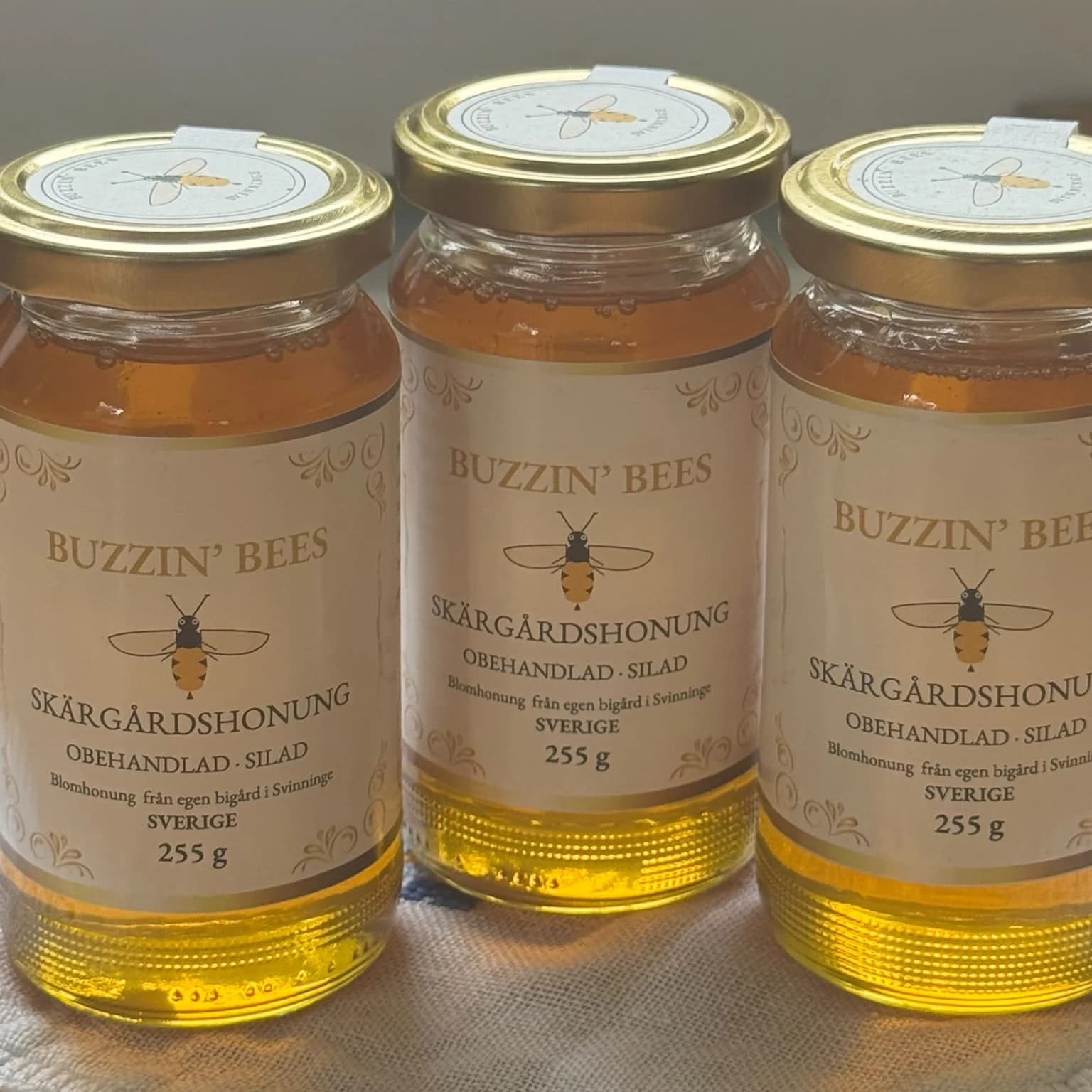
Our archipelago honey from Svinninge is blossom honey — pale, from nectar, strained but not filtered, and never heated above hive temperature. The water content is 17 %.
It will crystallise at the bottom if it is left to stand. It is supposed to.
Sources
Council Directive 2001/110/EC relating to honey (EUR-Lex) for the categories, composition criteria and designations · Allt om Honung (alltomhonung.se) for consistency, varietal honey and the heather honey requirements and handling · Allt om Biodling (alltombiodling.se) for honeydew · the Swedish Beekeepers' Association honey assessment for the assessment criteria.
Products mentioned in this article
You might also need
This is written by a working apiary, not an agency
Buzzin’ Bees is in Svinninge. We sell the honey our own hives make, and the Dr. Gost supplements we bring into Sweden.