Why Honey Never Spoils: the Chemistry, the History and the Unsolved
By Adam M Akkemik — beekeeper in Svinninge · Jordbruksverket registered · Biodlarna Stockholm member
Four mechanisms keep honey from spoiling, and only one of them is the sugar. What honey is made of, what the Egyptian tomb story actually supports, what the oldest surgical papyrus says — and the question about royal jelly that research has not closed.
Honey is the only thing in an ordinary pantry that has no best-before date for chemical reasons. The date on our label is there because the law asks for one, not because the honey runs out of time. This article is about why — what honey actually is, what makes it so strangely durable, what the oldest writings say about it, and the part of the story research has still not closed.
Nothing here is a health claim. It is chemistry, archaeology and bee biology, and where there is a gap in what is known, we say so.
What honey actually is
A jar of honey is about eighty per cent two sugars — fructose and glucose — plus water. Ours sits at 17 % water. The rest, that last small percentage, is what decides everything else: enzymes the bees add themselves, pollen grains from the flowers, organic acids, minerals, and the volatile aromatics that let two honeys from the same county taste nothing alike.
Bees do not make honey by collecting it. They make it. Nectar arriving in the hive is largely sucrose and can be seventy or eighty per cent water. The bees add the enzyme invertase, which splits that sucrose into the simpler sugars, and then they drive off the water — moving the droplet between their mouthparts and fanning with their wings until the content is down around twenty per cent or lower. Only then is the cell capped with wax. The cap is the bees' own receipt that the work is finished.
That is why a capped frame means something. Honey taken before the bees have put the lid on themselves is not finished, however it looks.
Why it does not spoil
Four things work at once, and it is the combination that does the job.
There is not enough water to go round. Micro-organisms need free water to grow. In honey almost all the water is bound up with the sugar, and what is left is not enough. The technical term is low water activity; in practice it means there is nothing to live on.
It draws water in rather than giving it up. Honey is hygroscopic. An open jar in a humid kitchen takes moisture from the air — which is the one route to a honey that can actually ferment, and the reason the lid belongs on.
It is acidic. The pH sits around 3.5–4.5, roughly orange juice. That is an uncomfortable place for most of what would otherwise like to grow there.
The bees add an enzyme that makes hydrogen peroxide. As they ripen the honey the bees add glucose oxidase. In finished, concentrated honey the enzyme is effectively idle, but when the honey is diluted it activates and produces small amounts of hydrogen peroxide. It is one of nature's more elegant arrangements: the protection switches on only when the honey is thinned — which is exactly when it would be vulnerable.
All of that depends on the jar staying closed and dry. Opened, damp and carelessly kept, any honey will ferment eventually. The chemistry is not magic, it is a balance — and once the jar is in your kitchen, that balance is yours to keep.
The jars in the tombs, and what is actually established
The most quoted honey story is that archaeologists found pots in Egyptian tombs holding honey that was still edible after thousands of years. It turns up everywhere, and it deserves honest handling, because the two halves of the claim rest on very different evidence.
That honey appears in Egyptian grave finds is well documented. Honey was part of the goods buried with the dead, and vessels with honey residue have been recovered and identified. Egyptians used honey in food, in offerings and in embalming, and written sources from the same culture confirm how central it was.
That it was "perfectly edible" is an anecdote that has outgrown its evidence. The phrasing can be traced back through popular science writing to a handful of early twentieth-century accounts, and it has been repeated far more often than it has been sourced. We say so plainly because the honest version is the more interesting one: you do not need the anecdote to be impressed. The chemistry above is quite enough to explain why honey survives a thousand years in a sealed vessel — and that part is measurable rather than told.
What the oldest writings say
Honey is among the oldest documented foods in human use, and it appears in the earliest texts we still have.
The Edwin Smith Papyrus, dated to around 1600 BC and widely described as the oldest surviving surgical text, names honey in dressings for wounds. The Ebers Papyrus of the same period includes it in a large number of recipes. Honey recurs in Dioscorides in ancient Greece, in Roman household writing, in the Ayurvedic tradition, and in religious texts from several cultures.
We are reporting what the records contain. This is history, not a recommendation for how honey should be used today — we sell a food and nothing else, and what you do about a wound is a question for a doctor rather than a beekeeper. But it says something about how long people have taken this particular substance seriously, and that is worth knowing while you are holding a jar of it.
Why it crystallises — and why that is a good sign
Sooner or later almost all natural honey turns grainy. It comes down to the ratio of glucose to fructose, which is to say to the flowers the bees were on: glucose is the sugar that comes out of solution first, and the more of it there is, the faster the honey sets. Rapeseed honey goes solid in weeks. Acacia can stay liquid for years.
Crystallisation therefore tells you how the honey was handled, not whether it is genuine. A honey that was heated hard and filtered stays liquid longer, precisely because something was taken out of it — the crystal seeds, the pollen, some of the enzymes. A grainy jar is a confirmation rather than a fault. How to bring it back without losing what is left is in Crystallised honey.
The part that is still unsolved
Here is the section that deserves the most respect, because it is about something still open.
Take two freshly laid eggs from the same hive, from the same queen, genetically equivalent. Have the nurse bees feed one royal jelly the whole way through the larval stage, and the other the same jelly for the first days only and then a plainer brood food.
The first becomes a queen: larger, with working ovaries, living for years and laying thousands of eggs a day. The second becomes a worker that lives a few weeks in summer and lays nothing at all. Same genome. Entirely different animals. The difference is the food.
That it happens has been known for a long time. How it happens is still not fully settled. Research has moved along two partly converging tracks: epigenetics — the idea that the food changes which genes are expressed, through DNA methylation among other mechanisms, rather than changing the genes themselves — and the search for what in the jelly triggers it. A protein named royalactin was put forward as the decisive factor in a much-discussed 2011 study, but later work has questioned that conclusion, and the question is not closed. It is still being worked on at universities today.
It is worth pausing on. A colony that knows nothing about genes decides, by choosing what to feed a larva, whether it becomes the one individual that can carry the colony forward. And we can describe what happens without being able to explain fully why.
What it means for the jar in your cupboard
Practically, and briefly:
- Keep it at room temperature with the lid on, dark and dry. A fridge is not needed and only speeds up crystallisation.
- Never heat it above 40 °C. The enzymes and the aroma are the most delicate things in honey. Why that particular line, and what happens in a cup of tea, is in Honey in hot tea.
- Never give honey to a child under one. Honey can contain spores of Clostridium botulinum. An adult gut handles them; an infant gut is not finished. That applies to all honey, however pure — ours included.
- Low water content is shelf life. Ours is 17 %, and the assessment scale starts at 16 while anything above 20 is not approved at all. That is not a number for show; it is precisely the number that lets the jar stand for a long time.
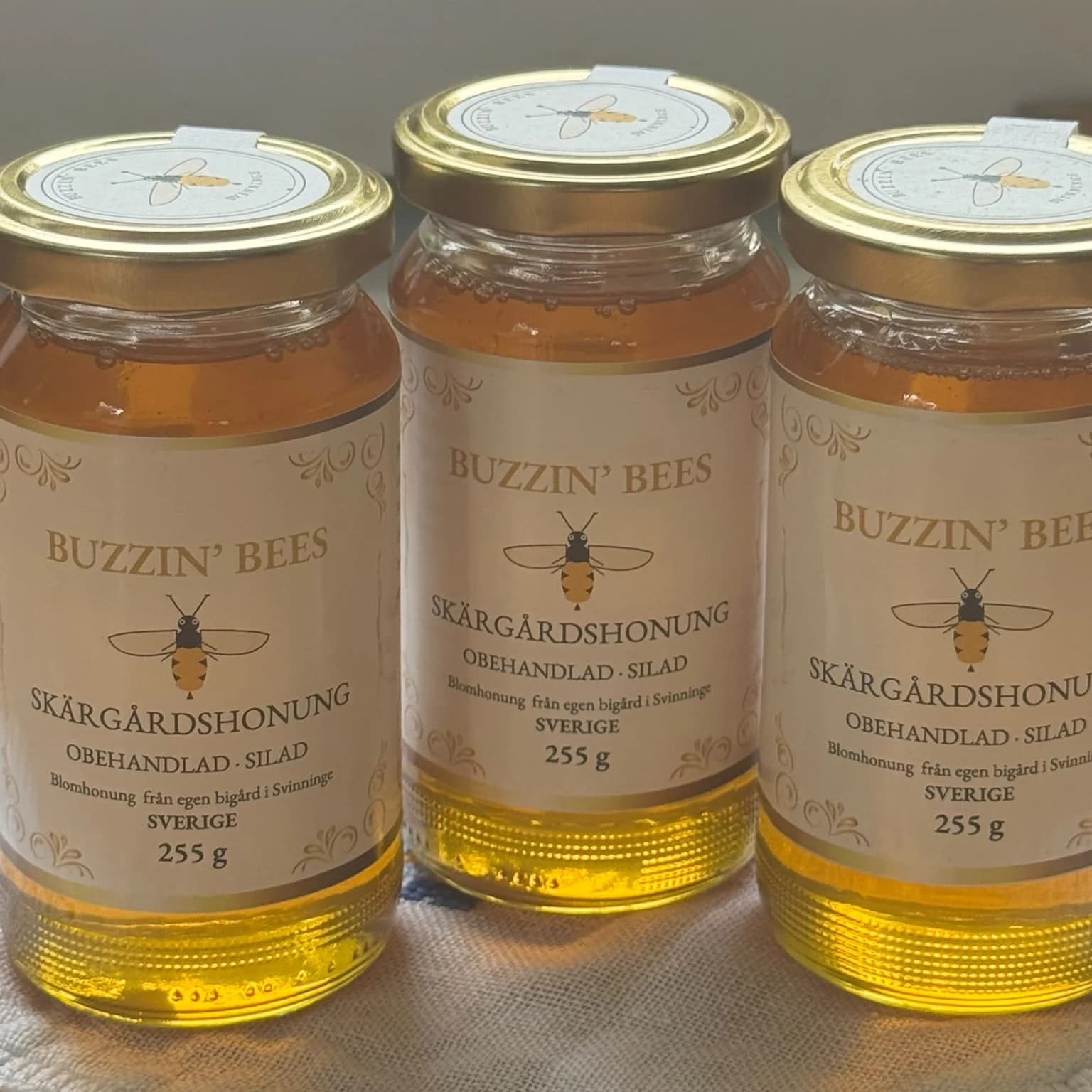
Our own archipelago honey from Svinninge is strained, never heated above hive temperature, and bottled on site — which means everything above applies to it directly, including that it will crystallise at the bottom if it is left to stand. It is supposed to.
Products mentioned in this article
You might also need
This is written by a working apiary, not an agency
Buzzin’ Bees is in Svinninge. We sell the honey our own hives make, and the Dr. Gost supplements we bring into Sweden.