Organic Honey: What the Word Requires, and Why So Few Swedish Jars Carry It
By Adam M Akkemik — beekeeper in Svinninge · Jordbruksverket registered · Biodlarna Stockholm member
Organic is not a taste or a grade — it is a certificate, and in the EU the word itself is protected. What the rules actually require, why three kilometres is the hard part for bees, how certification works in Sweden, and the questions to ask a beekeeper when there is no label to read.
Organic honey is not a taste, and it is not a quality grade. It is a certificate, and in the EU the word itself is protected. A producer may print organic on the jar only once a control body has examined the operation and issued a certificate. Without it the word is forbidden, however the bees are actually kept.
That is worth knowing before you go looking for the label, because it explains something that surprises most people: a great deal of Swedish honey produced roughly the way the rules describe carries no label at all.
What do the rules require?
The rules are in EU Regulation 2018/848. For beekeeping the decisive point is 1.9.6.5 in Annex II: within three kilometres of the apiary, the nectar and pollen sources available to the bees must consist essentially of organically produced crops, natural vegetation, forest, or crops grown using low environmental impact methods.
That one sentence holds the whole difficulty. A carrot grower controls their field. A beekeeper controls the hive — but not the nearly 2,800 hectares lying within three kilometres of it. The bee does not ask about property lines.
Beyond siting there are requirements on conversion, on the wax in the frames, on what may be fed, on how the hive is managed and on documenting all of it. The full conditions are more than an article should list, and they change; Jordbruksverket and the control bodies hold them in full.
Why so few Swedish jars carry the mark
Two reasons, and the first is not carelessness.
Geography. In farming country, three kilometres without conventionally cultivated land is hard to find. No amount of better beekeeping fixes it.
Cost and paperwork. The Swedish trade site Allt om Biodling says plainly that many of Sweden's beekeepers run their apiaries on ecological principles but carry no label, because of the extra work and the cost of certification. For someone with a few hives, the annual fee and the inspection are a large item against what a couple of hundred jars bring in.
So the absence of the mark says less than people assume. It says nobody has paid to have the matter checked. Not that the honey is worse — and not that it is better.
Where our own hives stand
The order matters here, so we will take it in the right one.
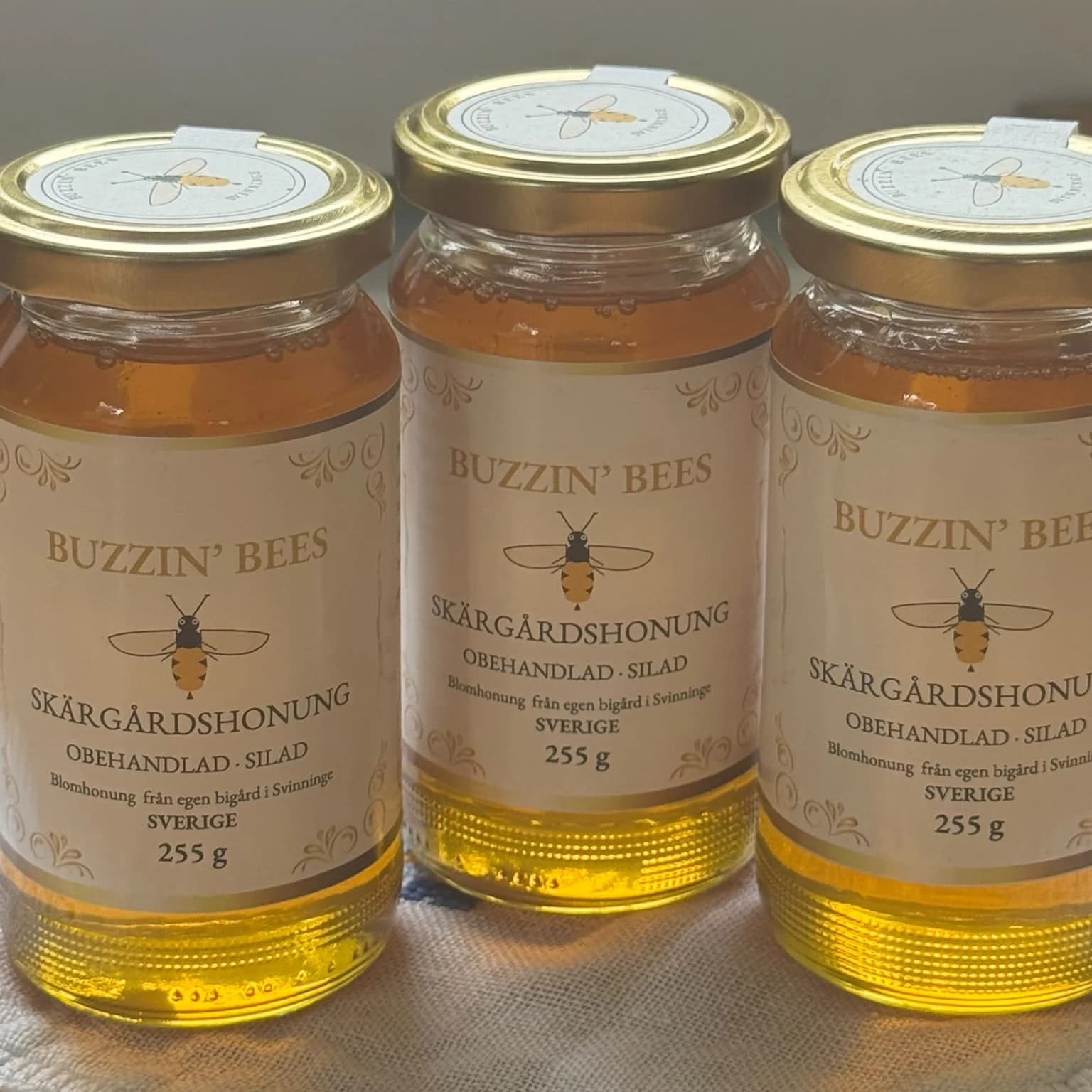
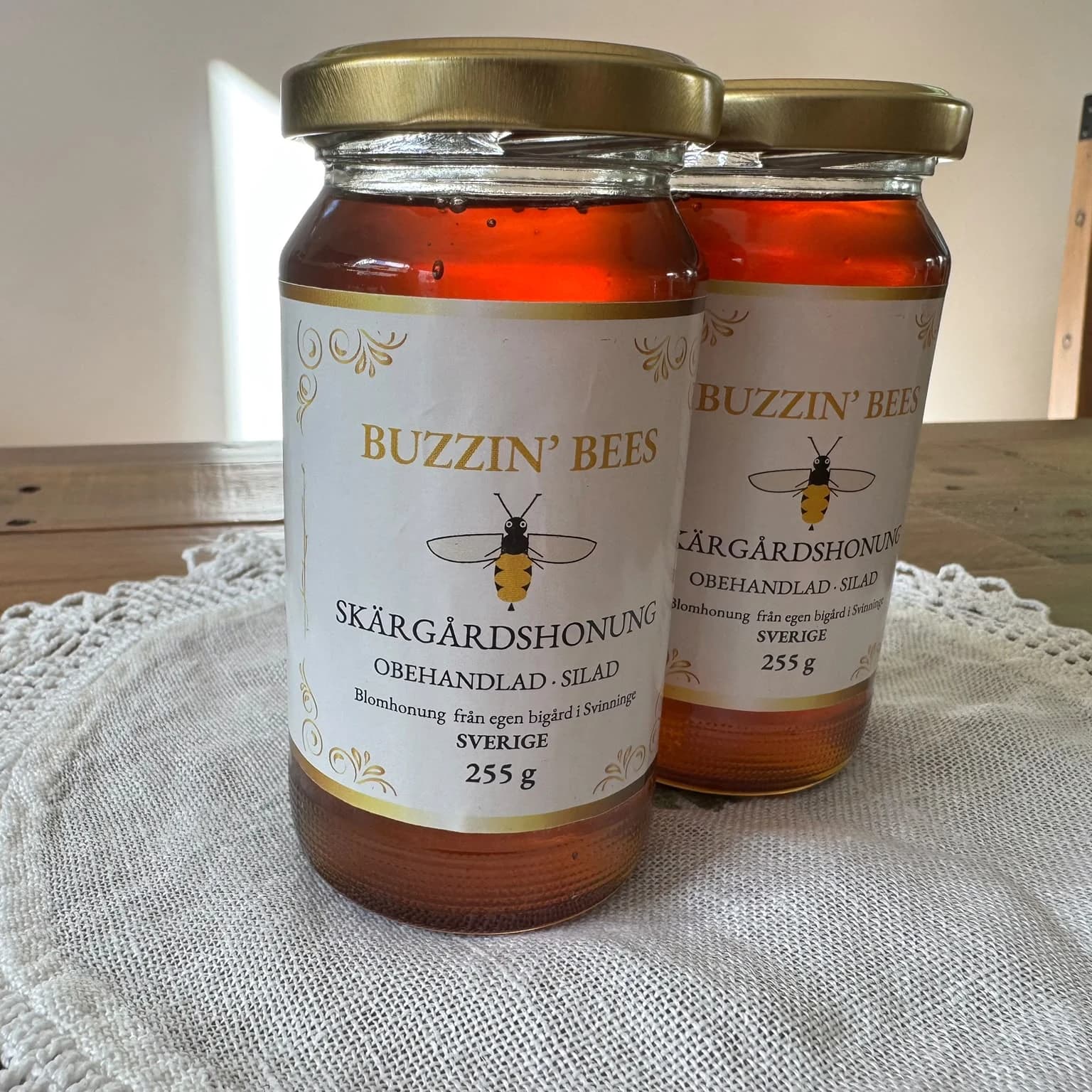
We are not certified organic, and so we do not call our honey organic. The word belongs to whoever holds the certificate. We do not hold it. What we can do is tell you where the hives stand and what we do with the honey, and let you judge.
The hives are at Svinninge in Österåker, on the edge of the Stockholm archipelago. There are no large cultivated fields within the bees' flight range. What is there is the Näsudden nature reserve, forest, meadow, and old gardens with apple, pear and plum trees; around Svinninge the lilac, mock orange, honeysuckle and lavender flower thickly, and the pine woods run down to the water.
That is a description of a place. We are not claiming the place satisfies the regulation — that question is settled by a control body rather than by us, and we have not put it to one.
About the honey itself we can say things that were measured: water content is 17 % in the Skärgårdshonung and 18 % in the Sensommarhonung. We never heat it above the hive's own temperature. We strain it — wax and particles out, pollen in — and do not fine-filter. Both harvests passed the Swedish Beekeepers' Association honey assessment in 2026.
What to ask a beekeeper instead
The label is a shortcut. With no shortcut you ask the questions yourself, and there are not many:
- Where do the hives stand, and what is within a few kilometres? Field, forest, town or reserve.
- Has the honey been heated, and above what temperature? Above the hive's own temperature, aromas and enzymes begin to go.
- Strained or fine-filtered? Fine-filtering removes the pollen, and with the pollen the trace of where the honey came from.
- What is the water content? Above 20 % fails assessment; lower keeps better.
- Has anyone outside the apiary assessed it?
A beekeeper who has measured their own answers these standing up. One who has not cannot — and that is an answer in itself.
Is organic honey better?
It depends what you mean by better.
Certification regulates the beekeeping method: where the hives stand, what is fed, what is used in the hive. It does not regulate whether the honey is raw. A certified honey can be heated and fine-filtered. An uncertified one may have had none of that done to it.
If you want to know how the bees were kept, the mark is a good answer. If you want to know what is left in the jar, it is the wrong question, and the list above holds the right ones.
Questions and answers
How do you become a certified organic beekeeper in Sweden?
You register the operation with Jordbruksverket and then apply for certification with a control body. You sign an agreement undertaking to follow the EU rules and to receive inspection visits. Once the control body approves the production you receive a certificate, and the control body normally visits at least once a year.
What does it cost?
The fee is set by the control body and depends on the size of the operation, so that figure comes from them — we have none of our own to quote. Expect both an annual fee and the work of the documentation.
Is there a route for someone with only a few hives?
Yes. Small-scale beekeepers can be certified as a group of operators: several join and are certified together rather than separately. That is the route that makes the mark possible for anyone who cannot carry the cost alone.
May I write "organic" if I follow every rule but hold no certificate?
No. The word and its forms — organic, eco, bio — are protected in the EU and may be used only by the holder of the certificate. That applies on the jar, on the website, in advertising and in brand names.
Is KRAV the same as EU organic?
No. The EU rules are the floor; KRAV is a Swedish mark with its own rules on top of that floor. A KRAV-marked honey therefore meets both.
How do I know a jar really is certified?
The packaging must carry a code identifying the control body. If it is missing, the product is not certified, whatever the surrounding text implies.
Frequently asked questions
What does "organic honey" actually mean?
It is neither a flavour nor a grade — it is a certificate, and in the EU the word itself is protected. A producer may print organic on the jar only once a control body has examined the operation and issued a certificate. Without it the word is forbidden, however the bees are actually kept.
What do the EU rules require of an organic apiary?
The decisive point is 1.9.6.5 in Annex II of Regulation 2018/848: within three kilometres of the apiary, the nectar and pollen sources available to the bees must consist essentially of organically produced crops, natural vegetation, forest, or crops grown using low environmental impact methods. Beyond siting there are requirements on conversion, on the wax in the frames, on what may be fed, on hive management and on documentation. A carrot grower controls their field; a beekeeper controls the hive but not the nearly 2,800 hectares around it.
May I write "organic" if I follow every rule but hold no certificate?
No. The word and its forms — organic, eco, bio — are protected in the EU and may be used only by the holder of the certificate. That applies on the jar, on the website, in advertising and in brand names. This is why we do not call our own honey organic: we are not certified, so the word is not ours to use.
How do you become a certified organic beekeeper in Sweden?
You register the operation with Jordbruksverket and then apply for certification with a control body. You sign an agreement undertaking to follow the EU rules and to receive inspection visits. Once the control body approves the production you receive a certificate, and the control body normally visits at least once a year. The fee is set by the control body and depends on the size of the operation.
Is there a route for a beekeeper with only a few hives?
Yes. Small-scale beekeepers can be certified as a group of operators: several join and are certified together rather than separately. That is the route that makes the mark possible for anyone who cannot carry the cost of annual certification alone.
Why do so few Swedish honey jars carry the organic mark?
Two reasons, and the first is not carelessness. Geography: in farming country, three kilometres without conventionally cultivated land is hard to find, and no amount of better beekeeping fixes it. Cost and paperwork: the Swedish trade site Allt om Biodling says plainly that many of Sweden’s beekeepers run their apiaries on ecological principles but carry no label, because of the extra work and the cost of certification. So the absence of the mark says less than people assume — it says nobody has paid to have the matter checked.
Is organic honey better than uncertified honey?
It depends what you mean by better. Certification regulates the beekeeping method: where the hives stand, what is fed, what is used in the hive. It does not regulate whether the honey is raw. A certified honey can be heated and fine-filtered; an uncertified one can be neither. If you want to know how the bees were kept, the mark is a good answer. If you want to know what is left in the jar, ask about heating, filtering and water content instead.
How do I know a jar really is certified organic?
The packaging must carry a code identifying the control body. If it is missing, the product is not certified, whatever the surrounding text implies.
Products mentioned in this article
You might also need
This is written by a working apiary, not an agency
Buzzin’ Bees is in Svinninge. We sell the honey our own hives make, and the Dr. Gost supplements we bring into Sweden.