Crystallised Honey: What It Tells You, and How to Turn It Back
By Adam M Akkemik — beekeeper in Svinninge · Jordbruksverket registered · Biodlarna Stockholm member
A grainy jar is not a spoiled jar. Why glucose is always the sugar that goes first, what crystallisation really proves (processing, not authenticity), and the two-minute water-bath method that does not cost you the enzymes.
A jar that has stood a few months goes grainy at the bottom, then solid, and the first question is always the same: has it gone off?
No. It has done the one thing that separates honey from syrup, and it is worth understanding before you do anything about it.
It is the glucose
Honey is a supersaturated sugar solution — there is more sugar dissolved in it than the water in it can properly hold. It stays that way because it is thick and cold and nothing has disturbed it, not because it is stable. Sooner or later some of that sugar comes back out of solution, and it is always the glucose that goes first.
The reason is simple arithmetic. Glucose dissolves in water at about 47 g per 100 g. Fructose dissolves at about 385 g per 100 g — eight times as much. So in any honey, the glucose is the sugar sitting closest to its limit, and it is the glucose that forms the crystals.
Which means the ratio between the two decides almost everything:
- Fructose-to-glucose below about 1.11 — sets quickly, often within weeks.
- Above about 1.3 — slow, months or a year.
- Above about 1.58 — in practice it never sets at all.
That is not a quality scale. It is a description of what the bees were foraging on.
Which honeys, and when
Rapeseed (raps) is the extreme case and it matters here, because it is the first big crop of the Swedish season. Rapeseed honey is very high in glucose and will set hard in the jar within weeks — sometimes before you have finished bottling it. Beekeepers extract it promptly for exactly this reason.
Dandelion, clover and heather all set readily. Most Swedish summer blends will granulate over a winter.
Acacia sits at the other end and can stay liquid for years. So can some honeydew honeys. They are not better or fresher; their sugar ratio is simply on the other side of the line.
What crystallisation actually tells you
Here is where a popular claim needs correcting, because the useful version of it is stronger than the version people repeat.
You will often read that crystallisation proves honey is real, and fake honey does not crystallise. As a test of authenticity that does not work in either direction. Genuine acacia honey stays liquid for years, and adulterated honey with glucose syrup in it will crystallise perfectly happily. Believing the test would have you throw out good honey and trust bad honey.
What crystallisation does tell you about, reliably, is processing.
Crystals cannot form out of nothing. They need something to start on — a pollen grain, a fleck of wax, an air bubble. These nucleation sites are exactly what industrial processing removes: ultrafiltration strips out the pollen and the particles, and heating dissolves the tiny seed crystals that would otherwise grow. Do both and you get honey that sits perfectly clear on a shelf for three years.
So a jar that granulates is telling you it still contains what it was bottled with. That is a real thing to know, and it is the honest version of the claim: crystallisation is evidence about how the honey was treated, not about whether it is honey.
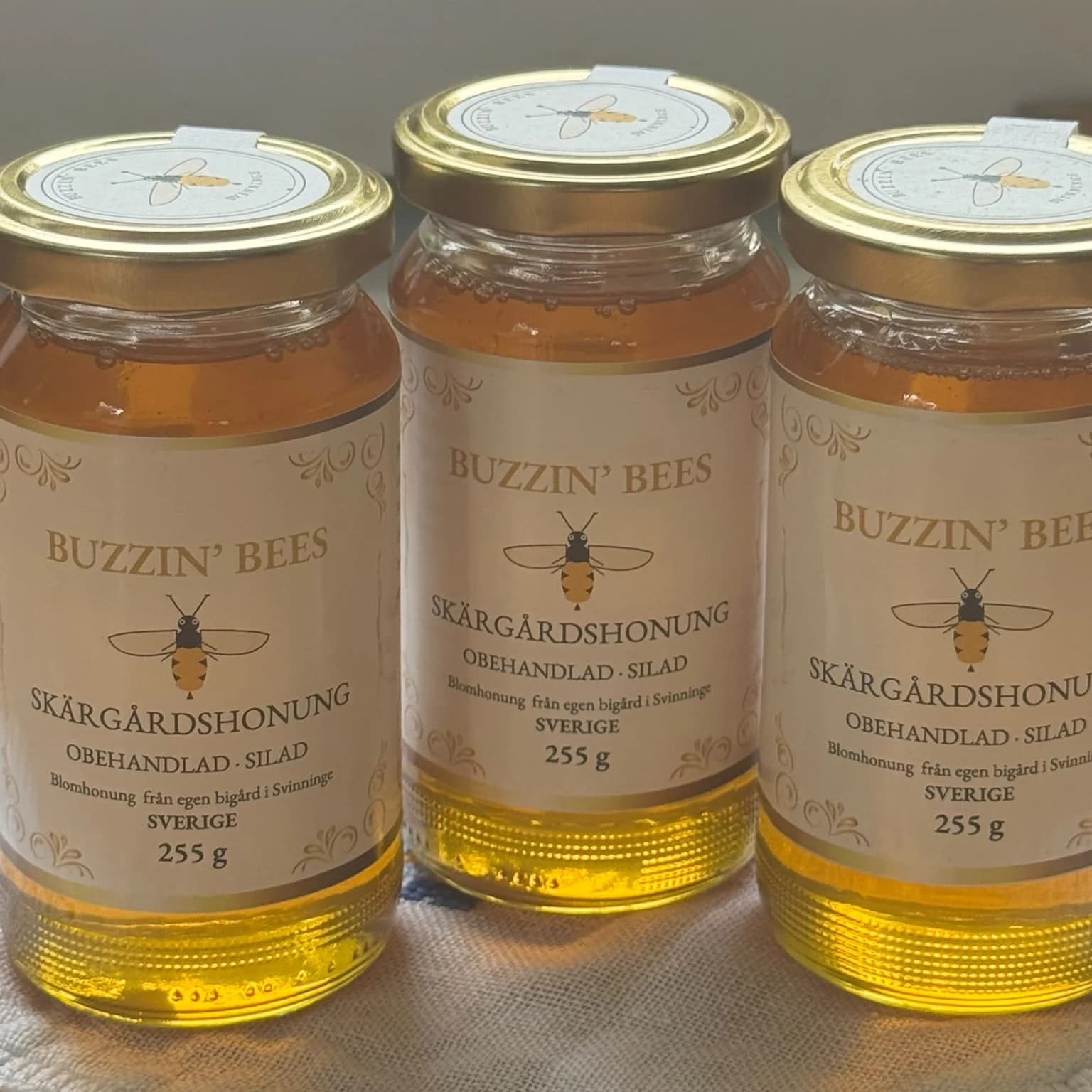
Our own Skärgårdshonung from Svinninge is untreated and strained, and it granulates for exactly this reason.
Turning it back, without wrecking it
The method is dull and takes a wooden spoon.
1. Run tap water into a bowl at about 40 °C. You do not need a thermometer: 40 is roughly where a hand stops finding water comfortable, so the test is simply that you can hold your hand in it without wanting to pull it out. The damage threshold is higher than that (see below), which is the point — the hand test leaves you margin.
2. Stand the open jar in it, so the water comes up the sides but not over the rim.
3. Stir the honey gently and continuously with a wooden spoon.
For the usual case — a layer of crystals at the bottom of a jar that is otherwise liquid — that is two or three minutes, and it comes back the way it was bottled.
The stirring is the whole trick, not an afterthought. Honey is a poor conductor of heat: left alone, the outside of the jar gets hot long before the middle gets warm, so you end up cooking the edges to reach a core that is still solid. Stirring carries the heat inwards instead of waiting for it to conduct, which is why a few minutes at a gentle temperature does what an hour of standing does not.
A wooden spoon because it does not conduct heat away, does not scratch the glass, and does not chill the honey the way cold metal does.
A fully set jar is the same method with more patience. Keep the water in the same range, top it up as it cools, keep stirring, and expect it to take considerably longer. What you must not do is raise the temperature to speed it up — that is the one move that costs you something.
Never: the microwave, a pan on the hob, or boiling water. All three will liquefy honey in minutes and take the enzymes with it.
Why 50 °C is the line
Heat damage in honey is a matter of temperature and time together, not temperature alone.
Below about 40 °C, nothing measurable happens to honey at all — that is roughly hive temperature on a warm day. A few minutes at 50 °C costs very little. What does the damage is sustained heat, and anything approaching boiling: at 71 °C, diastase activity falls by 60 % or more within fifteen minutes, and honey stirred into fresh tea at 85 °C loses its enzymes on the way down.
That is the same rule, from the other end, as the one in Honey in Hot Tea — worth reading if you have ever wondered whether the tea question is real.
And it will do it again
Honey that has been brought back will granulate again, usually faster the second time, because the process leaves behind seed crystals to start from.
That is not a fault and it is not a sign you did it wrong. It is a jar of honey behaving like a jar of honey — and the alternative, a jar that never changes at all, is usually a jar that had the reason for changing removed before it reached you.
A set jar has one practical advantage on bread, incidentally: it does not run off. And if you still do not know what to do with it, there are eleven suggestions in honey in the kitchen.
Frequently asked questions
Has my honey gone off if it has gone grainy?
No. Crystallisation is honey doing what honey does — most varieties granulate sooner or later, and a jar that never sets at all is usually a jar that was heated or ultrafiltered hard enough to stop it.
Why does honey crystallise?
Honey is a supersaturated sugar solution, and it is always the glucose that comes out of solution first: glucose dissolves at about 47 g per 100 g of water while fructose dissolves at about 385 g. So the fructose-to-glucose ratio decides almost everything — below about 1.11 a honey sets within weeks, above about 1.58 it never really sets at all.
Does crystallisation prove that honey is real?
No, and the test fails in both directions: genuine acacia honey stays liquid for years, and honey adulterated with glucose syrup crystallises perfectly happily. What crystallisation does tell you about reliably is processing — crystals need a pollen grain, a fleck of wax or an air bubble to start on, and those are exactly what ultrafiltration and heating remove.
How do I turn crystallised honey back to liquid?
Run a bowl of water at 40–50 °C, stand the open jar in it so the water comes up the sides but not over the rim, and stir gently and continuously with a wooden spoon. A layer of crystals at the bottom of an otherwise liquid jar takes two or three minutes. The stirring is the trick, not an afterthought: honey conducts heat poorly, so without it you cook the edges to reach a solid core.
Which honeys set fastest?
Rapeseed is the extreme case and the first big Swedish crop of the season — very high in glucose, it sets hard within weeks and sometimes before bottling is finished, which is why beekeepers extract it promptly. Dandelion, clover and heather all set readily, and most Swedish summer blends granulate over a winter. Acacia sits at the other end and can stay liquid for years.
Will it crystallise again after I have liquefied it?
Yes, usually faster the second time, because the process leaves seed crystals behind for the next round to start from. That is not a fault and not a sign you did it wrong.
Products mentioned in this article
You might also need
This is written by a working apiary, not an agency
Buzzin’ Bees is in Svinninge. We sell the honey our own hives make, and the Dr. Gost supplements we bring into Sweden.