Honey
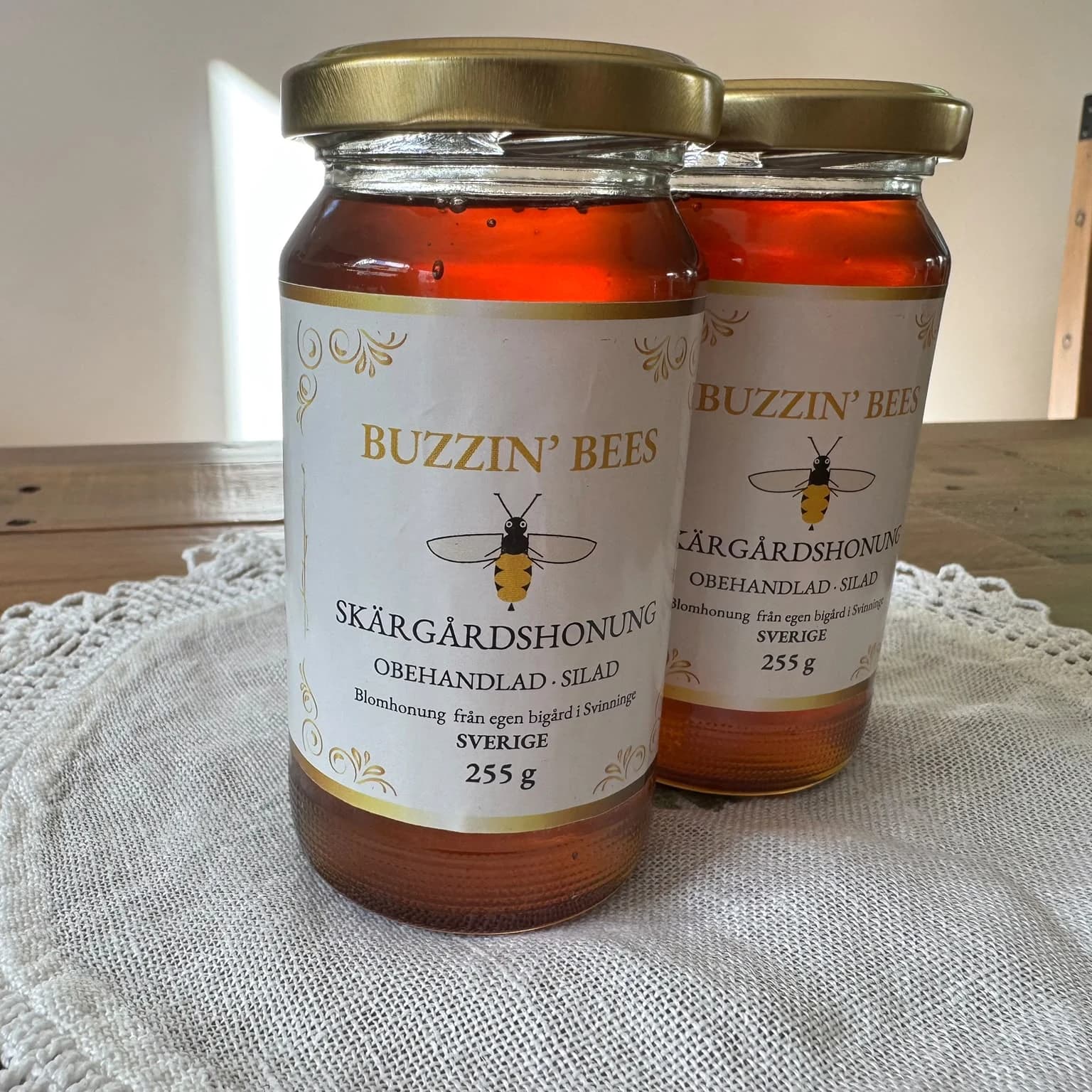
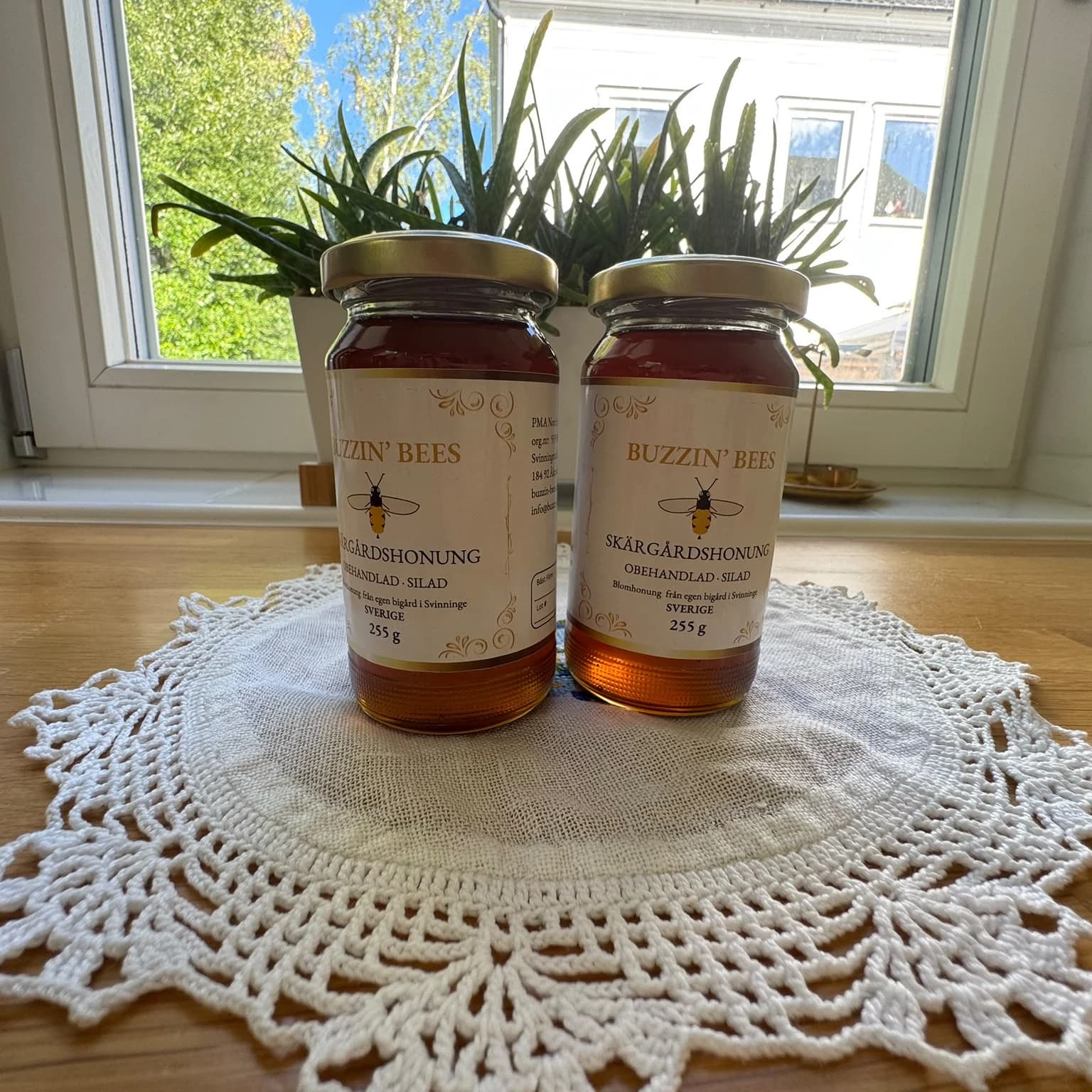
Sensommarhonung from Svinninge
A dark late-summer honey: flowery on the nose, with a tangy note and a little bite in the finish. 255 g, water content 18 %.
Unit price: 705.88 SEK/kg
🔒 Secure checkout · Card · Klarna · Apple Pay · Swish
🍯 Campaign: 3 jars — free shipping within Sweden · 🚚 DHL Service Point — from 99 SEK · Free shipping in Sweden from 1500 SEK on the whole order
📦 Our own warehouse in Sweden — your order is packed and sent from Åkersberga.
- 18 % water — approval stops at 20 %. Fully ripened, fully capped honey.
- One apiary, one harvest — not “a blend of EU and non-EU honeys”.
- Never heated above hive temperature — the enzymes and aromatics stay where they are.
- Strained, not filtered. The pollen stays — and with it the trace of where the honey came from.
- Approved in the Swedish Beekeepers’ honey assessment: purity, aroma, taste, consistency, colour and water content.
Product Description
What it is
- Product name
- Sensommarhonung (late-summer honey). Designation: honey. Country of origin: Sweden. Net quantity: 255 g. Harvest: late summer 2026.
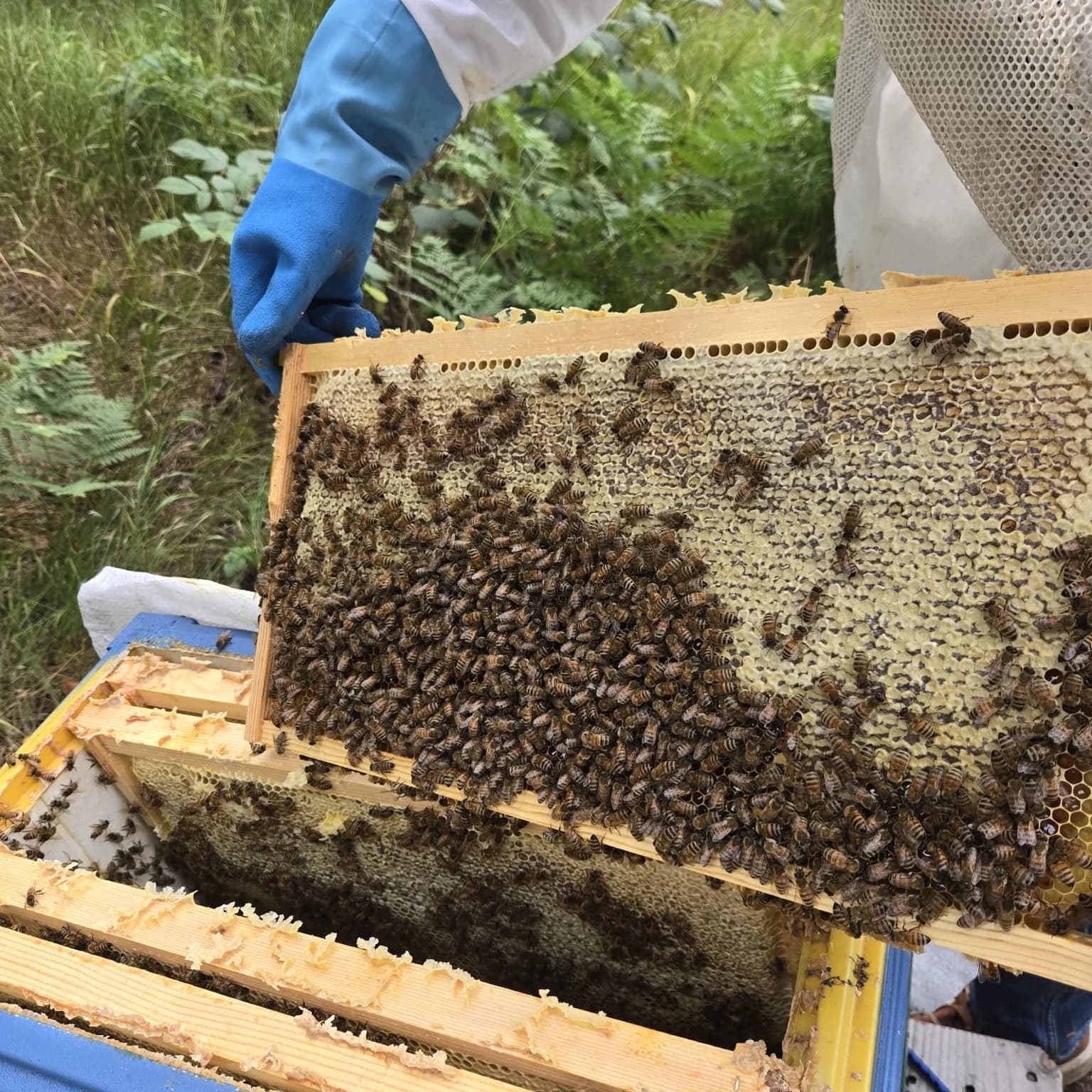
The same apiary, a different harvest. Late-summer honey from our own hives in Svinninge, Österåker — bottled from the last extraction of the season. Darker and stronger than the summer honey, and clearly its own thing.
The taste — in the assessor's own words
- The nose
- "flowery and a little sharp". The taste: "tangy, with a bit of bite". The colour sits at 8 out of 10 on the assessment scale — brown, considerably darker than early-summer honey. It pours freely and the texture is smooth.
This is not a mild honey, and we say so plainly so you know what you are buying. If you are used to pale, sweet summer honey, this one tastes of more: more character, a tangy note, a little bite in the finish. Many people prefer exactly that — with cheese, on dark bread, in tea.
Why it is darker
Late in the season there is less in flower on the ground, and the bees work more in the trees. That is our own observation from this apiary rather than an analysis — but it matches what we see in the jar: darker colour, stronger taste.
Three things we do not do
We do not heat it. The honey never goes above hive temperature, so the delicate enzymes and aromatics stay where they are.
We do not filter it. We strain it — wax and particles out, pollen in. Filtered honey is a different thing: the pollen is removed, and with it the trace of where the honey came from.
We do not blend it. No honey bought in from other beekeepers, nothing mixed from several producers. Extraction, straining and bottling all happen here.
Assessed by Biodlarna
- Measured water content
- 18 %. Anything above 20 % is not approved. None of the assessment's grounds for rejection — colour, aroma, taste, layering or water content — was marked.
Approved in the Swedish Beekeepers' Association honey assessment 2026 — purity, aroma, taste, consistency, colour, water content and packaging.
Food information
PMA Nordic AB, Svinningeuddsvägen 6 E, 184 92 Åkersberga, Sweden. Org.nr 559588-2159.
The best-before date and batch number are printed on the jar label.
Storage
Keep dry at room temperature with the lid on. Honey crystallises naturally over time — stand the jar in a lukewarm water bath, no hotter than 40 °C. Do not boil it.
Important
Do not give honey to children under 1 year. This applies to all honey.
End of product description.
Common questions
- Why does the honey taste and smell the way it does?
- It reflects what is in flower around the apiary. Svinninge sits in the Stockholm archipelago, and the forage is a mixed one — orchards and meadow flowers early, wild woodland flowers, lime and clover later. Blossom honey from a single apiary therefore does not taste the same two years running, and that is the point: a blend from several producers is evened out, this is not.
- Why is some honey light and some dark?
- It depends on what the bees had to work with, and when. Spring and early-summer honey is usually light: it comes from nectar in flowers, fruit trees and meadow plants. A harvest at the end of August or the start of September is often considerably darker, and the reason is that it may contain honeydew honey. Honeydew honey does not come from flowers at all. It comes from honeydew — the sweet secretion aphids and other sap-sucking insects leave behind on spruce, pine, oak, birch, willow, maple and fruit trees. The bees gather it exactly as they gather nectar and transform it with their own enzymes, and the EU honey directive counts it as a main type of its own alongside blossom honey. The taste is usually described as rich, fruity, tangy and full, with a long finish — a completely different experience from a pale June honey. The colour runs from light to dark, and from silver fir it can even tend towards green. Two things are worth knowing. Honeydew honey is high in fructose and can therefore stay liquid for a long time, which is often mistaken for a high water content — that should be checked with a refractometer, not by eye. And honeydew carries no pollen of its own, so the origin cannot be established by pollen analysis; the laboratory looks at the sugar spectrum instead. For the beekeeper there is a downside too: aphids on spruce can produce what is called cement honey, which sets hard in the comb itself and becomes very difficult to extract. This is what makes honey worth following year after year. As with wine, the place and the season say something, and a practised palate hears the difference between a June honey and a late-summer honey from the same apiary. Which of the two this particular jar is, the product text above says.
- A layer has formed at the bottom of the jar — has my honey gone off?
- No. A jar that has stood for a few months crystallises at the bottom, and that is not a fault — it is a sign of real, untreated honey and of what it carries. It comes back in a couple of minutes. Stand the closed jar in a bowl of water up to half the jar's height, around 35–40 °C — warm to the hand, not hot enough to scald. Leave it a few minutes, then stir slowly for a minute or two with a wooden spoon or a stick. The crystals dissolve, you have liquid honey again, and it goes back to how it was bottled. The stirring is the whole trick: honey conducts heat poorly, so without stirring the edges get warm while the middle is still solid. Do not let the water go above 40 °C, and never top it up with boiling water while the jar is standing in it. A microwave, a pan on the hob and boiling water all liquefy honey in minutes and take the enzymes with it.
- Why has the honey crystallised?
- Because it is the real thing. All natural honey crystallises sooner or later, and how fast depends on the ratio of glucose to fructose — that is, on which flowers the bees were on. Glucose is always the sugar that goes first. Crystallisation tells you how the honey was handled rather than whether it is genuine: a honey that was heated hard stays liquid longer precisely because something was taken out of it.
- What happens to honey heated above 40 °C, or stirred into hot tea?
- Honey in tea is the question we get most often, and the answer is a temperature. Below about 40 °C nothing measurable happens — that is roughly hive temperature on a warm summer day, and honey is built for it. Above that three things go, in order: glucose oxidase first, then invertase, then diastase. At 71 °C diastase falls by 60 % or more in fifteen minutes, and at 80 °C the breakdown that takes a month at 40 °C takes about an hour — invertase is finished in under ten minutes. HMF rises at the same time, formed when sugars break down under heat and acidity; the EU honey directive caps it at 40 mg per kilo. Tea is served at 80–90 °C, so a spoonful stirred into a fresh cup reaches brewing temperature in seconds. Toxic it never becomes — HMF is regulated as a freshness and processing marker rather than as a poison, and you take in more of it from a cup of coffee or a handful of dried fruit. But it is no longer what you paid for: the sweetness stays, the enzymes and the aroma do not. Let the tea cool to drinkable first.
- What do raw and unpasteurised mean?
- Raw honey means exactly that: unheated above hive temperature, and strained rather than filtered — so it reaches you unfiltered, with the enzymes, pollen and aromatics still in it. Unpasteurised is the same thing said another way. Since 14 June 2026, honey filtered so that its pollen has been significantly removed may no longer be sold as honey at all, only as baker's honey (Swedish regulation LIVSFS 2025:3). Straining is still permitted, and the law counts pollen as a natural constituent of honey — not as an ingredient. Ours is strained, so the pollen stays.
- Why does honey not spoil?
- Three things at once. The water content is low and honey is hygroscopic, so it draws water in rather than giving it up. It is acidic, around pH 3.5–4.5. And the bees add the enzyme glucose oxidase as they ripen it. Together that makes honey one of the few foods that needs no preservative at all. Ours is 18 %.
- Is it true that honey thousands of years old has been found unspoiled?
- Yes, and it is the best-known illustration of how stable honey is. Jars of honey have been recovered from Egyptian tombs and described as unspoiled after millennia — not our claim, but one of archaeology's more widely reported observations. The explanation is the one above: low water, hygroscopy, low pH and the bees' own enzyme. The condition is that the jar stays sealed; opened and damp, any honey will eventually go off.
- What do the oldest writings say about honey?
- Honey is among the oldest documented foods in human use, and it appears in the earliest surviving texts. The Edwin Smith Papyrus, dated to around 1600 BC and known as the oldest surviving surgical text, names honey in dressings for wounds; the Ebers Papyrus of the same period includes it in a large number of recipes, and it recurs in Dioscorides in ancient Greece and in the Ayurvedic tradition. We are reporting what the records contain — this is history, not a recommendation for how honey should be used today.
- How does a larva become a queen instead of a worker?
- From the same egg. The difference lies entirely in what the nurse bees feed it: a future queen is given royal jelly the whole way, while a worker gets it only for the first days and then a plainer brood food. The outcome is two different animals — a worker that lives a few weeks, and a queen that lives for years and lays thousands of eggs a day. Exactly how the food drives that is still not fully settled; research points to epigenetic changes and to components of the jelly, and it remains an area under study at universities.
- How much work is behind one jar?
- Over its whole life a single bee produces roughly one twelfth of a teaspoon of honey. A 255 g jar is therefore the sum of a great many bees and a great many trips — for one kilo the figure usually given is on the order of two million flower visits. It is why we only harvest what the colony can spare: the jar is the bees' work, not ours.
- What is honey made of?
- Mostly fructose and glucose, around 80 % between them, plus water. The rest is the small part that decides everything else: enzymes from the bees, pollen grains, organic acids, minerals and aromatics from the flowers. It is why two honeys from the same country can taste nothing alike.
- Can people with diabetes eat honey?
- Honey is sugar. Around 80 % of it is fructose and glucose, and in energy terms it does not differ much from other sugar. Anyone watching their blood sugar should count honey as they would any sugar and take the question to their own care provider — it is not ours to advise on.
- How does honey differ from ordinary sugar?
- Refined sugar is sucrose and nothing else. Honey is mostly fructose and glucose, already inverted by the bees, and it carries what the flowers put into it: enzymes, pollen grains, organic acids, minerals and the aromatics that make one honey taste unlike another. It is an unrefined food the bees finished themselves. In energy terms it is still sugar, which is the honest thing to say alongside that.
- Can honey be toxic?
- Swedish honey from ordinary forage is not. The phenomenon exists elsewhere: honey from certain rhododendron species can carry grayanotoxin, which is the origin of “mad honey”. It takes a flora we do not have. One exception applies everywhere and has nothing to do with quality: honey should not be given to children under one year.
- Why should children under one not eat honey?
- Honey can contain spores of Clostridium botulinum. An adult gut handles them without difficulty; an infant gut is not finished yet. The recommendation covers all honey, however pure or however well assessed — ours included.
- Where does the honey come from?
- From our own apiary in Svinninge in the Stockholm archipelago. One apiary, one harvest — no honey bought in from other beekeepers and nothing blended from several producers. Extraction, straining and bottling all happen here, and we know which hives each jar came from.
- How do I know the quality holds up?
- The honey is approved in the Swedish Beekeepers’ Association honey assessment, which covers purity, aroma, taste, consistency, colour, water content and the packaging as well — somebody other than us saying it. The water content is 18 %: the scale starts at 16 % and anything above 20 % is not approved at all, so the honey was fully ripened and capped before we took it.
- What happens if the water content is too high?
- The honey can start to ferment. Water is what decides shelf life, and above about 20 % the sugar-tolerant yeasts get a foothold. The EU honey directive draws the line there: honey that has begun to ferment may not be sold as honey at all. It has a legal category of its own — baker's honey — "suitable for industrial uses or as an ingredient in other foodstuffs", and under Swedish regulation LIVSFS 2025:3 the label has to carry the words "for cooking and baking only" right beside the name. So it is not lost: fermented honey goes into baking and into mead, the honey wine that is one of the oldest drinks in the Nordic countries. It is simply no longer table honey. And 20 % is a ceiling rather than a target — a genuinely good honey should not sit above 19 %, and the limit is set at 20 precisely to leave margin. Heather honey is the exception and may go up to 23 %. The higher the water, the sooner the jar should be eaten. Ours is 18 %.
- How should it be stored, and how long does it keep?
- At room temperature with the lid on, dark and dry. A fridge is not needed and only speeds up crystallisation. The best-before date is on the label, usually a long way off — see the question on why honey does not spoil.
- How much honey is in a jar, and will it last?
- 255 g net. We bottle in small batches from this year’s harvest, and when the season runs out the sales run out — the next batch comes after the next harvest. Three jars ship free within Sweden while the harvest lasts.
- Can I return an opened jar?
- No. Foodstuffs whose seal has been broken cannot be returned for health and hygiene reasons (EU Consumer Rights Directive art. 16). The outer shipping box does not count — you may open the parcel and look at the goods. A jar with its seal intact can be returned within 14 days.
Why your honey may crystallise
Raw, unfiltered honey naturally crystallises — this is a sign it hasn’t been heat-treated. To restore it, place the jar in a 40 °C water bath for 20 minutes. Never microwave.
Learn more about raw honey →Reviews
No reviews yet
This product is new to the range. We email a link to everyone who buys it, ten days after delivery — and we publish what they write, whatever the rating.
The rating is calculated from verified purchases only. We email a one-time link to the address used on the order — such a review cannot be left without a purchase. Signed-in members may also comment on a product they have not bought; those comments appear separately, without a verified-purchase mark, and do not affect the rating. We publish positive and negative reviews alike and remove them only on stated grounds, never for being unflattering.
- Jordbruksverket-registeredFeed business operator SE67569098
- Biodlarna StockholmStockholm Beekeepers Association
- Our own warehouseWe pack and post within Sweden
- NPA memberPackaging producer responsibility
- Secure checkoutCard · Klarna · Apple Pay · Swish