The Buzzing Hour
The Honey Puzzle: Why It Never Spoils, and What We Still Cannot Explain
Listen to this episode
Honey is the one thing in the pantry with no chemical expiry date. We take apart the four mechanisms that keep it — only one of which is the sugar — check what the Egyptian tomb story actually supports, read what the oldest surgical papyrus says, and end on the question research has not closed: how the same egg becomes a worker or a queen depending only on what it is fed.
Honey is the one thing in an ordinary pantry that cannot go off — not "keeps well", not "keeps if you are careful", but cannot, for chemical reasons. The date on our jar is there because the law wants a date on a food. It is not the honey running out of time.
This episode takes that apart. We go through the four mechanisms that keep honey stable, and only one of them is the sugar everybody guesses. We check the famous story about honey found in Egyptian tombs, which is half documented and half anecdote, and we say which half is which. And we finish on the part of this that is still genuinely unsolved.
Along the way: why bees do not collect honey but make it, why a capped frame is the bees' own signature on finished work, why a grainy jar is a good sign rather than a fault, and the two-minute fix for it that does not cost you the enzymes.
In this episode
- What honey actually is: roughly eighty per cent fructose and glucose, seventeen per cent water, and the small remainder that decides everything
- Invertase, wing-fanning and the wax cap — how nectar at seventy per cent water becomes honey at seventeen
- The four mechanisms: low free water, hygroscopy, a pH around 3.5–4.5, and glucose oxidase as a built-in alarm that only wakes when the honey is diluted
- The Egyptian tomb story, and which half of it the evidence actually supports
- Honey in the Edwin Smith and Ebers papyri, in Dioscorides and in Ayurveda — as history, not as a recommendation
- Why honey crystallises, what that says about how it was handled, and the water-bath method at about 40 °C
- Royal jelly and the queen: same egg, different food, different animal — and why the mechanism is still an open question
Key takeaways
- Honey is stable because four things act at once, and the protection from glucose oxidase switches on only when the honey is diluted — exactly when it would be vulnerable
- The jars in Egyptian tombs are well documented; "still perfectly edible" is an anecdote repeated more often than it is sourced, and the chemistry explains the durability without it
- Crystallisation tells you about processing, not authenticity: a hard-heated, filtered honey stays liquid longer because something was taken out of it
- To reliquefy: closed jar, water bath at about 40 °C — hand-warm, no thermometer needed — and stir for a couple of minutes, because honey conducts heat poorly
- Never heat honey above 40 °C, and never give honey to a child under one year
Products from this episode
You might also need
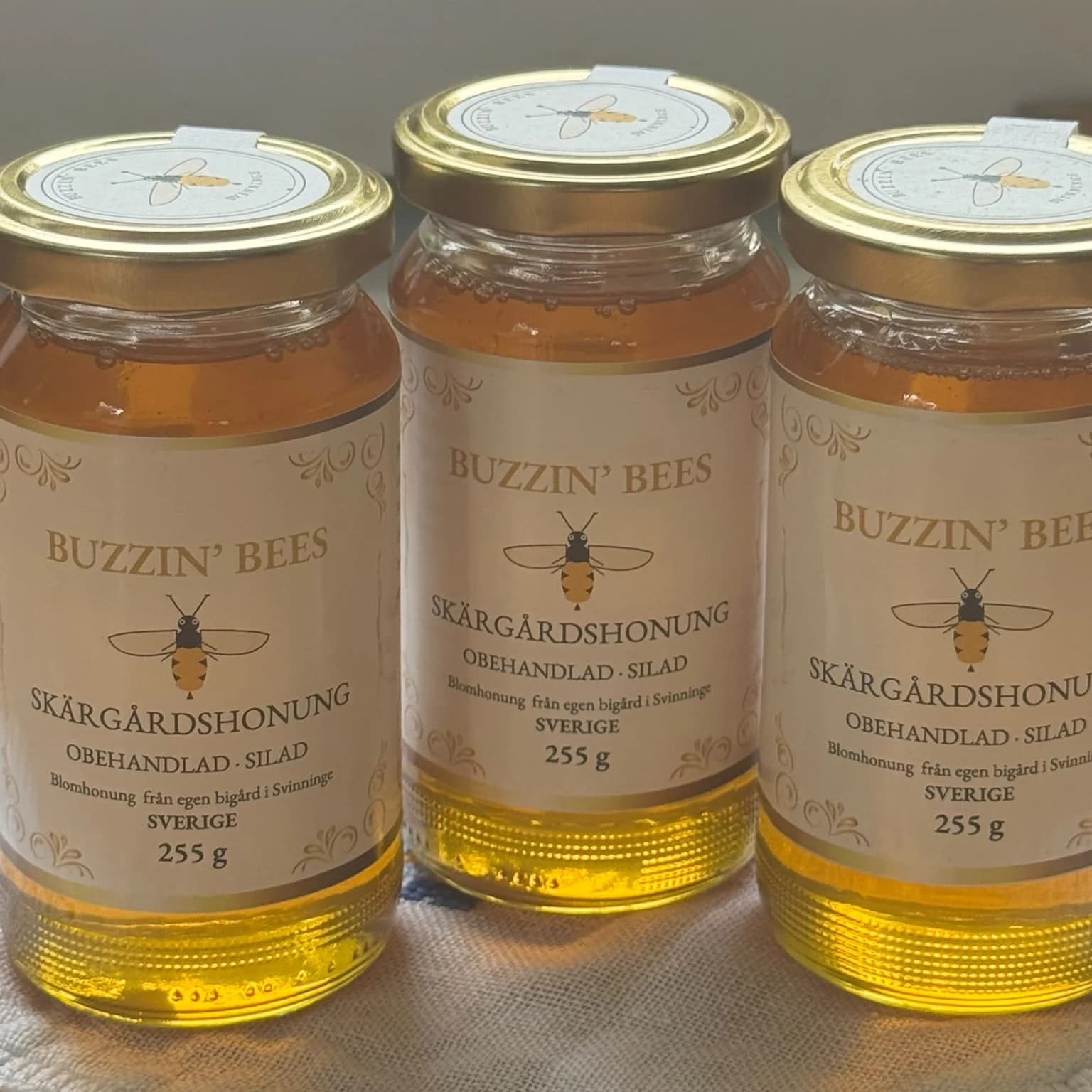
This is written by a working apiary, not an agency
Buzzin’ Bees is in Svinninge. We sell the honey our own hives make, and the Dr. Gost supplements we bring into Sweden.