Probiotics and prebiotics for bees: what the gut flora does, and where the evidence stops
By Adam M Akkemik — beekeeper in Svinninge · Jordbruksverket registered · Biodlarna Stockholm member
A bee carries a gut flora of five to nine core bacteria that help digest pollen and prompt its immune defences. That much is well studied. Whether the supplements sold to support it work is a separate question — and the field studies are not encouraging. Both halves, plus what we do in our own apiary.
Beekeepers ask about this more than about almost anything else we sell. At the honey assessment in September 2026 it was the first thing people wanted to talk about: what probiotics actually do for a colony, and what prebiotics have to do with it.
The short answer is that the bee's own gut flora is real, well studied and genuinely important — and that the evidence for the supplements sold to support it is much thinner than the marketing around them. Both halves belong in the same article.
A honeybee carries its own gut flora
A worker bee's gut holds a small, remarkably consistent bacterial community. Five to nine core lineages account for most of it: Snodgrassella alvi and Gilliamella apicola along the ileum wall, Lactobacillus Firm-4 and Firm-5 and Bifidobacterium in the rectum, and a few others in smaller numbers.
It is not decoration. Research on the honeybee gut community links it to nutrition and weight gain, to hormonal signalling, to the breakdown of pollen, and to immune function. Snodgrassella alvi triggers the bee's own antimicrobial peptides — apidaecin, defensin, hymenoptaecin — which is the bee defending itself, prompted by a bacterium it carries.
Pollen is where much of this happens. Pollen grains are armoured, and part of the work of getting protein out of them falls to the gut bacteria. A colony with poor pollen diversity does not only lack protein; it also feeds its own flora worse.
The flora is inherited from the colony, not picked up from flowers
A newly emerged bee is almost sterile. It acquires its gut community in the hive, from the faeces of nestmates, from the comb surfaces, and from mouth-to-mouth feeding. That is why the colony — not the individual — is the unit that carries the flora, and why a hive with old, healthy bees passes on something a package of bees on new comb has to rebuild.
What prebiotics are, and why they are named together with probiotics
Probiotics are live bacteria given in the hope that they will establish and do something useful.
Prebiotics are not bacteria at all. They are the food the bacteria live on — fibres and sugars the bee itself does not digest, which reach the gut intact and feed what is already there.
The comparison people reach for is the human one: drinking kefir now and then adds bacteria, but they only settle if the gut has something to feed them. Give the bacteria without the food and you are seeding a field you have not watered. That is the reason the two words appear on the same label, and it is a fair description of the idea behind them.
Where the evidence actually stops
This is the part that is usually left out, and leaving it out is why beekeepers do not trust product claims.
The science on the bee's own flora is solid. The science on commercial supplements that claim to support or restore it is not.
- A longitudinal field study of commercial colonies, published in Scientific Reports in 2024, found that non-native probiotics marketed for honeybees had no measurable effect on pathogen prevalence or on the bees' microbiome.
- A review of the field concludes that evidence for probiotic benefit in social bees is lacking or mixed, and notes that most species used in commercial products are not native to the bee gut at all.
- A separate test of a commercially sold probiotic found no evidence that it restored the gut community, and called for more work.
None of that says supplements are useless. It says the studies that would show a benefit have mostly not been done, and the ones that have been done did not find one. A beekeeper deciding what to buy deserves that sentence rather than a slogan.
Two questions follow from it, and they are the right questions to ask of any product on the shelf, ours included: which species and strains does it contain, and are they species that live in a bee's gut? A product that cannot answer the first question cannot be assessed at all.
What does support the flora, with no product involved
- Pollen diversity. Varied forage feeds a varied flora. A colony on one crop, or on pollen substitute alone, has been shown to end up with a less diverse gut community.
- Not letting the colony starve. A starving colony eats its own reserves and its flora goes with them.
- Not moving combs between colonies carelessly. The flora travels with the comb, and so does everything else.
- Leaving the bees alone in cold weather. Every opening costs heat, and a chilled colony is a stressed one.
What we do in our own apiary
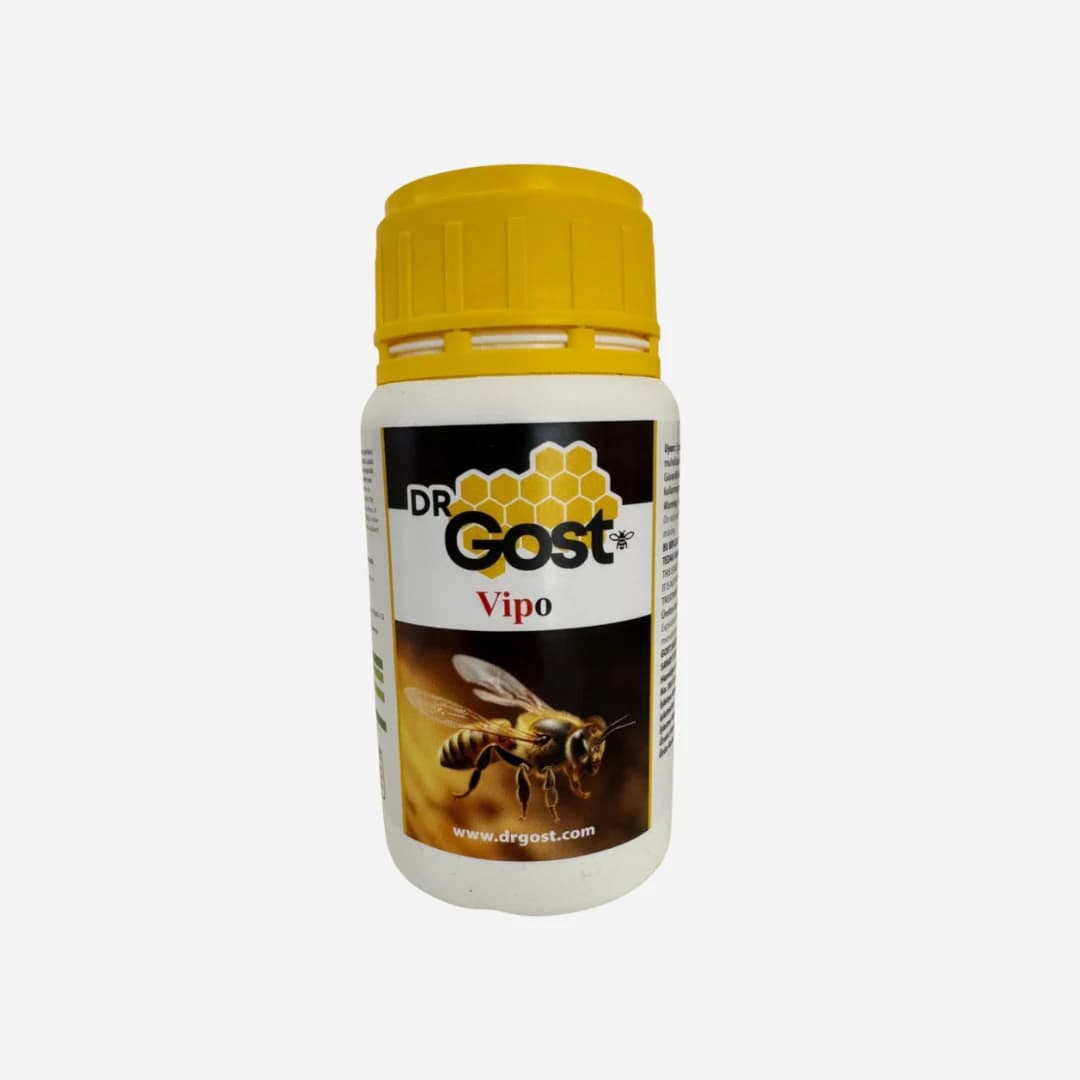
The autumn mix is one bucket of ready-made feed, 12.5 litres, with 200 ml each of three liquid supplements stirred in and 25 g of the powder that carries the vitamins, protein, prebiotics and probiotics. The manufacturer's dose for the powder is 2 g per kilo.
Our colonies go into the autumn on two boxes, and a colony that size takes a bucket like that in about two and a half days. A smaller colony will take longer, so the figure is only useful next to the number of boxes it came from. They take the bucket without the powder as well — appetite is not where we see a difference.
This season the beekeeper gave the powder to seven colonies and not to the others, and saw more brood in the ones that got it. One colony that had been the strongest in the apiary went without and came out no better than average.
We are recording that as an observation, and it is worth writing down. It is not evidence, and we will not present it as evidence. The colonies were not matched for starting strength, the choice of which got it was not random, the person counting frames knew which colonies had been fed, and a hive that starts unusually strong tends to look more ordinary at the next inspection whatever you do to it.
So next spring we will do it properly: twelve colonies paired by starting strength, the treatment assigned by a coin, brood frames counted on a fixed schedule. One season of that is worth more than five seasons of impressions, and whatever it shows — including nothing — we will publish it here.
Sources
- The honeybee microbiota and its impact on health and disease — pmc.ncbi.nlm.nih.gov
- Horak, Leonard & Moran (2020), Symbionts shape host innate immunity in honeybees, Proc. R. Soc. B 287: 20201184 — doi.org
- Honey bees as models for gut microbiota research — pmc.ncbi.nlm.nih.gov
- A longitudinal field study of commercial honey bees shows that non-native probiotics do not rescue antibiotic treatment, and are generally not beneficial (Scientific Reports, 2024) — nature.com
- Prospects for probiotics in social bees — pmc.ncbi.nlm.nih.gov
- Testing the effectiveness of a commercially sold probiotic on restoring the gut microbiota of honey bees — pubmed.ncbi.nlm.nih.gov
- A review of diet and foraged pollen interactions with the honeybee gut microbiome — pmc.ncbi.nlm.nih.gov
Products mentioned in this article
You might also need
This is written by a working apiary, not an agency
Buzzin’ Bees is in Svinninge. We sell the honey our own hives make, and the Dr. Gost supplements we bring into Sweden.